

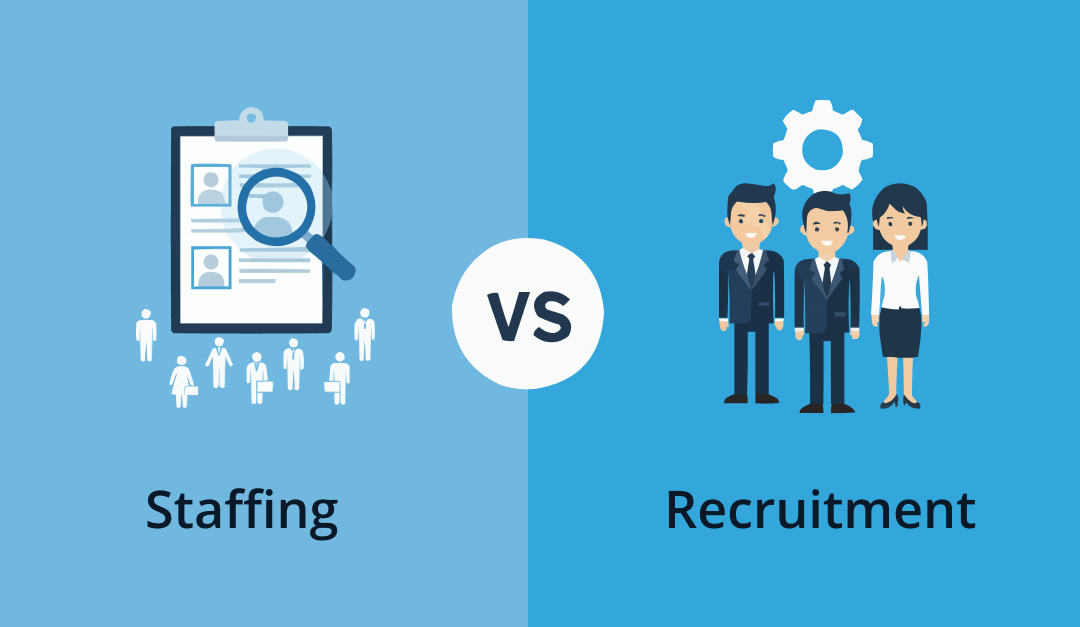
Every business has moments when it needs more hands on deck. Sometimes it is for a short period, such as covering someone on leave or accelerating the pace on a significant project. Other times, it is about finding someone who will stay and grow with the company.
At first glance, both situations seem similar. After all, they both involve hiring someone. But the way businesses handle them is not always the same.
That’s where the terms’ staffing’ and ‘recruitment’ often come into play. They sound alike, and people use them interchangeably. But they are actually quite different in how they work, when they are used, and what outcomes they aim for.
This blog explains the difference between staffing and recruitment, so you understand what each one means and when it is appropriate to use it.
Understanding Staffing
Staffing is about filling positions quickly. It often comes into play when a business needs someone to step in for a short period or for a specific project.
Here’s what staffing usually involves:
- The company has a gap, possibly because someone’s on leave, a deadline is tight, or there’s extra work.
- The need here is for someone who can begin quickly and complete the work without delay.
- The role could last anywhere from a few days to a few months.
Staffing is typical in industries like:
- Retail (extra staff during holiday seasons)
- Events and hospitality (crew for specific functions)
- IT (contract-based project work)
- Healthcare (locum and relief staff)
Staffing companies in Hyderabad and other cities usually handle:
- Candidate search
- Contracts
- Payroll and admin
- Compliance checks
The process moves fast. The goal is to keep operations running without delay.
Understanding Recruitment
Recruitment is the process of hiring someone to fill a position. Recruitment is focused on placing individuals in roles that are designed to last and support business continuity over time.
In recruitment:
- The company needs to hire for a permanent role
- There’s a clear job description and career path
- The process involves screening, interviews, and reference checks
This is the space where companies look for the right skills, experience, and culture fit.
Recruitment agencies in Mumbai and other cities covers:
- Sales reps
- Software engineers
- Marketing professionals
- Finance and admin roles
- Senior leadership positions
It can be done in-house or through recruitment agencies, depending on the resources available.
The aim here is to find someone who can grow with the business.
Difference Between Staffing And Recruitment – Side by Side
Let’s break it down clearly across the most critical areas.
| Area | Staffing | Recruitment |
| Purpose | To get someone in the seat quickly | To find a long-term team member |
| Duration | Short-term, project-based, or temporary roles | Ongoing or permanent roles |
| Process | Quick turnaround, ready-to-go candidates | Structured, with multiple steps |
| Activities | Sourcing, paperwork, compliance, onboarding | Sourcing, screening, interviews, selection |
| Final Goal | Keep business moving without disruptions | Build a stable and skilled workforce |
Each process serves a real need. What matters most is understanding what the role demands, and choosing the right path to fill it.
Choosing What Fits Your Business
Here is where this all matters.
Let’s say a warehouse has a spike in orders during the summer. They do not need full-timers; they need a team of 15 workers who can start next week and stay for a month. That is staffing.
Now, imagine a company wants to hire a digital marketing lead to head up a brand-new department. This person will plan campaigns, manage budgets, and report to leadership. That is recruitment.
The choice depends entirely on what is needed at that moment. You should be aware of the nature of the role, the timeline, and the level of support the business requires to find the right person.
Hiring Made Easy with CIEL HR!
CIEL HR supports businesses with both staffing and recruitment. Some situations call for short-term placements, such as seasonal roles or project-based positions. Others involve permanent hires, where the person becomes a long-term member of the team.
The way CIEL HR works is straightforward. The team studies the request, understands the role, examines the timeline, and matches candidates who meet the need. The process is designed to eliminate uncertainty and ensure hiring remains aligned with real business needs.
A company may approach CIEL HR for multiple needs simultaneously: to meet immediate demand with contract staff and to support ongoing growth with permanent employees. The same support system handles both, ensuring continuity without confusion.
Hiring plays a direct role in how smoothly a business runs. CIEL HR focuses on ensuring that each placement, whether temporary or permanent, contributes to that goal.
