

Table of Contents
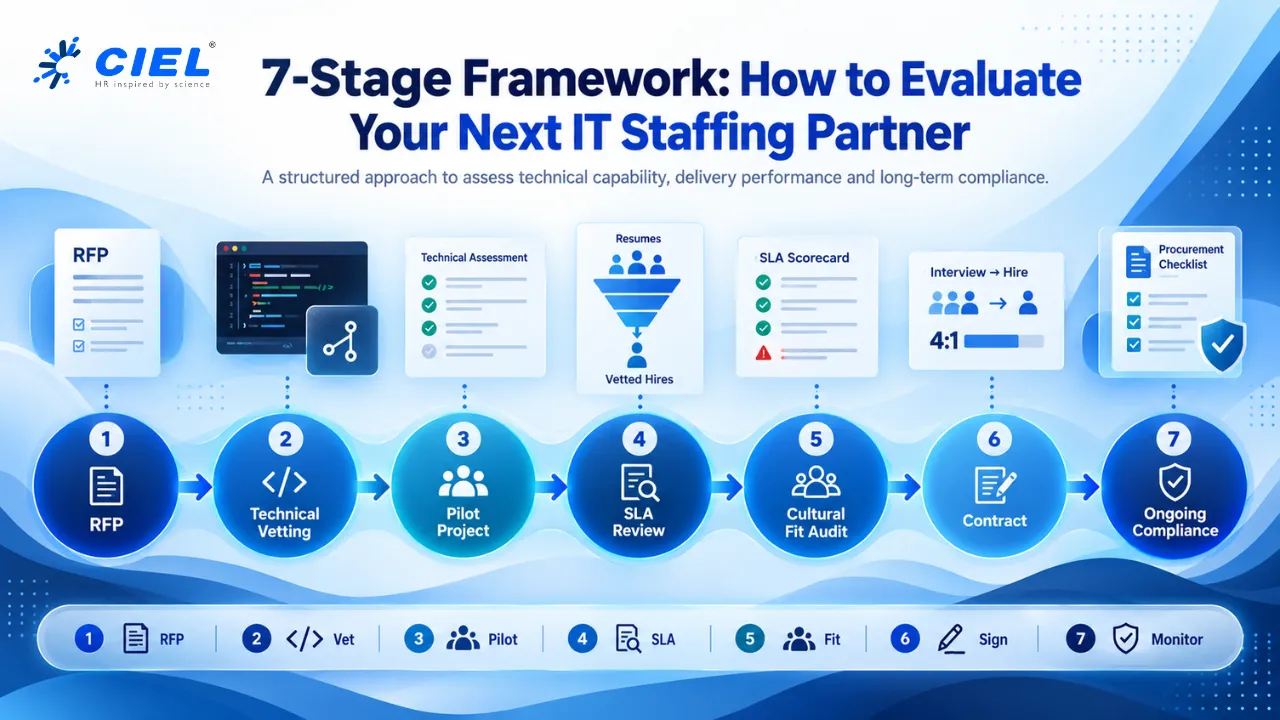
How to Select an IT Staffing Partner: A 7-Stage Evaluation Framework for Enterprise Hiring
How Do Enterprise Teams Evaluate IT Staffing Partners Effectively?
How do enterprise engineering teams evaluate an IT staffing partner when standard RFPs fail to differentiate vendor capabilities? The most effective way to select an IT staffing partner is to evaluate their proprietary vetting mechanisms, technical pipeline velocity, and SLA accountability rather than relying on standard resume volume.
An IT staffing partner executes targeted talent acquisition pipelines to deliver vetted technical professionals, reducing enterprise time-to-hire by aligning candidate capabilities with specific project architectures. By shifting the evaluation focus from contingent labor pricing to operational screening rigor, procurement teams can separate high-value technical partners from generic resume aggregators.
Why Do Traditional IT Staffing Vendor Evaluations Fall Short?
Traditional IT staffing evaluations rely on generic keyword matching and high-volume candidate submittals, which obscures the vendor’s actual technical vetting depth. This approach overwhelms internal engineering managers with unqualified interviews and extends the time required to fill critical roles.
Many enterprise procurement cycles treat IT staffing as a commodity purchase, grading vendors on markup percentages and the sheer size of their candidate database. This framework fails because an unvetted database holds no operational value. When evaluation scorecards ignore the specific mechanisms a vendor uses to validate code quality, system architecture knowledge, or agile methodology experience, the burden of screening falls entirely on the client. Understanding the staff augmentation and project-based delivery hiring models is necessary here; while project-based delivery shifts the outcome risk to the vendor, staff augmentation places the candidate directly into the internal workflow, making upfront vetting critical to operational continuity.
What Are the Core Criteria for Evaluating an IT Staffing Partner?
A comprehensive evaluation framework tests an IT staffing partner against specific performance KPIs, technical vetting rigor, and cultural alignment methodologies. Structuring the evaluation around these criteria ensures the vendor can consistently deliver engineering talent that integrates into existing enterprise workflows.
To determine what are the most important KPIs to measure the performance of an IT staffing agency , teams must look past gross submittals. As a working threshold, evaluate vendors against a candidate submittal time of 48 to 72 hours for standard roles, and demand an interview-to-hire ratio of 3:1 or better. A vendor’s ability to meet these metrics consistently indicates a mature, pre-screened talent pipeline.
Technical vetting infrastructure is equally critical. The vendor must demonstrate the use of recognized assessment platforms, such as HackerRank or GitHub repository reviews, rather than relying on recruiter intuition. Furthermore, to ensure a staffing partner can provide candidates that are a good cultural fit for an enterprise team, the evaluation must audit the vendor’s behavioral screening rubrics to verify they map directly against the enterprise’s communication protocols and team structures.
How Does a Bad Evaluation Impact the Enterprise?
Flawed evaluation criteria prioritize surface-level procurement metrics over technical vetting validation, leading to downstream operational bottlenecks. Identifying these gaps during the RFP stage prevents enterprises from onboarding staffing vendors that lack the required screening infrastructure.
Illustrative example:
A VP of Engineering at a mid-market financial services firm evaluates a new IT staffing vendor to scale a cloud migration team. The procurement scorecard heavily weights the vendor’s claimed submittal volume and low markup rates, bypassing a deep audit of the agency’s actual technical vetting mechanisms. The vendor wins the contract based on these surface-level metrics.
Within three weeks, the vendor submits forty candidate profiles for five open Site Reliability Engineering roles. On paper, the resumes match the job descriptions. In practice, the internal engineering managers spend twenty hours interviewing candidates who cannot explain basic Kubernetes orchestration or CI/CD deployment pipelines. The vendor’s vetting process consisted entirely of automated keyword scraping, pushing the actual technical screening onto the client’s internal team.
A correctly calibrated evaluation framework catches this gap during the RFP stage by demanding proof of technical assessment workflows and reviewing sanitized vetting reports. If the firm had required the vendor to demonstrate their screening process using a live code-pairing session, they would have disqualified the agency immediately. Instead, the flawed evaluation criteria resulted in a delayed cloud migration schedule and exhausted internal engineering resources.
What Questions Should Drive the RFP and Pilot Project?
A targeted Request for Proposal forces an IT staffing vendor to document their specific candidate screening workflows and SLA commitments. This documentation allows procurement teams to validate the vendor’s operational maturity before moving to a structured pilot phase.
Knowing what specific questions should be included in an RFP to test a staffing partner’s technical vetting process is the foundation of vendor accountability. Teams must ask how the vendor verifies architectural decision-making skills, who conducts the technical screens, and what security protocols govern candidate data. Following the RFP, knowing how to structure a pilot project to effectively test an IT staffing partner’s capabilities before signing a long-term contract prevents vendor lock-in. A pilot should be restricted to one or two well-defined roles to measure pipeline velocity and candidate quality in a controlled environment.
Use the following threshold logic to evaluate vendor responses and pilot performance:
- Technical Vetting Rigor: Submittal pass rate <50% = HIGH RISK. Action: Demand documented proof of technical screening platforms and internal technical recruiter credentials.
- Pilot Project Velocity: Time-to-first-submittal >5 days = HIGH RISK. Action: Restructure the pilot around a single, standardized engineering role to accurately test pipeline speed.
- SLA Compliance: Interview-to-hire ratio >4:1 = MEDIUM RISK. Action: Refine the cultural and technical feedback loops defined in the SLA to improve candidate targeting.
- Data Provenance: Lack of SOC 2 compliance = HIGH RISK. Action: Verify the vendor’s data handling policies for candidate information and proprietary technical assessments.
- Contractual Accountability: Absence of replacement guarantees = HIGH RISK. Action: Require a minimum 90-day candidate replacement clause in the final contract.
What Are the Trade-Offs of Adopting a Specialized IT Staffing Model?
Specialized IT staffing partnerships require deeper upfront integration and alignment than contingent workforce models . This operational investment yields higher-quality engineering candidates but demands dedicated time from internal technical leaders to calibrate the vendor.
- Not suitable when: The enterprise requires immediate, low-skill transactional labor where deep technical vetting and architectural alignment are unnecessary.
- Consideration: Internal engineering managers must commit time during the initial onboarding phase to calibrate the vendor’s technical screening rubrics and provide detailed feedback on early submittals.
- Trade-off vs alternative: A specialized IT staffing partner typically commands a higher bill rate markup compared to high-volume, generalized staffing agencies, trading upfront cost savings for reduced time-to-hire and higher retention.
How Do the IT Staffing Evaluation Approaches Compare?
An outcome-based IT staffing evaluation prioritizes technical vetting depth and SLA accountability over raw candidate volume. This shift in evaluation criteria directly reduces internal interview fatigue and accelerates the deployment of capable engineering talent .
By comparing these evaluation models, procurement teams can identify common red flags to watch out for when evaluating potential IT staffing vendors, such as an inability to commit to specific performance metrics.
| Feature | Outcome-Based Evaluation | Traditional Volume Evaluation |
|---|---|---|
| Primary Metric | Interview-to-hire ratio and retention | Total number of candidate submittals |
| Vetting Mechanism | Proprietary technical assessments (e.g., HackerRank) | Automated keyword matching on resumes |
| RFP Focus | SLA commitments and screening workflows | Markup percentages and database size |
| SLA Enforcement | Strict time-to-fill and replacement guarantees | Best-effort delivery with no penalties |
Evaluate your current vendor performance against these SLA thresholds to determine if a new IT staffing partner is required. Before launching your next RFP, ensure your procurement team has defined the necessary technical thresholds your vendor must meet. Contact our team to review your current IT staffing SLAs.
Frequently Asked Questions
How does an enterprise integrate an IT staffing partner with existing Applicant Tracking Systems (ATS)?
An IT staffing partner can integrate with enterprise Applicant Tracking Systems like Workday or Greenhouse via secure APIs to automate candidate data transfer. This ensures procurement and engineering teams track submittals, interview feedback, and compliance documentation within a single centralized platform.
What is the expected ROI timeframe when transitioning to a vetted IT staffing partner?
As a working estimate, enterprise teams should expect measurable improvements in their interview-to-hire ratio within the first 60 to 90 days of a pilot project. Long-term ROI is realized through reduced engineering hours spent conducting technical screens and lower project delay costs.
How does a staffing partner ensure candidates are a good cultural fit for an enterprise team?
To ensure a staffing partner can provide candidates that are a good cultural fit for an enterprise team, vendors must conduct behavioral interviews mapped to the client’s specific operational workflows. This includes assessing the candidate’s experience with the enterprise’s preferred agile methodologies, communication cadences, and remote collaboration practices.
What are the key differences between staff augmentation and project-based delivery hiring models?
The key differences between staff augmentation and project-based delivery hiring models center on management and output. Staff augmentation provides individual technical resources who integrate into the client’s internal team and are managed directly by enterprise leaders. Project-based delivery outsources the entire development lifecycle to the vendor, who assumes responsibility for the final deliverable.
What should be included in a service level agreement (SLA) with an IT staffing provider?
A service level agreement with an IT staffing provider must include strict submittal timelines, minimum interview-to-hire ratios, and candidate replacement guarantees. It should also define data privacy requirements, such as SOC 2 compliance, to govern how the vendor handles proprietary technical assessments.
What are common red flags to watch out for when evaluating potential IT staffing vendors?
Common red flags to watch out for when evaluating potential IT staffing vendors include a refusal to document their technical screening process, an inability to provide sanitized vetting reports, and an over-reliance on keyword-matching software without human technical validation.
