

Table of Contents
Building and Scaling Global Capability Centers for Enterprises
Many global organizations attempt to build offshore hubs to drive innovation, only to find themselves managing disconnected back-office teams. The goal is to distribute core capabilities across borders. The reality is often a fragmented operation that struggles to attract specialized talent and fails to integrate with the parent company.
This disconnect persists because traditional outsourcing frameworks treat talent as a commodity rather than a strategic asset. When leadership evaluates a new location based purely on cost arbitrage, the resulting facility lacks the operational maturity to handle complex engineering or product development. Without a structured talent acquisition and retention strategy , the hub suffers from high attrition and low output.
A Global Capability Center (GCC) integrates dedicated international talent pools directly into the enterprise operating model, enabling continuous product development and localized innovation. By replacing third-party vendor contracts with a captive or Build-Operate-Transfer (BOT) structure, organizations align remote teams with their central strategic goals. This approach shifts the focus from simple cost reduction to sustainable value creation.
How Do GCCs Shift the Focus from Cost to Capability?
Active organizational integration transforms a remote office into an innovation driver by embedding local talent directly into global product lines. This integration eliminates the traditional offshore handoff, ensuring that remote teams hold direct ownership over strategic deliverables rather than basic maintenance tasks.
Illustrative example:
A multinational financial services firm opens a new engineering hub in a highly competitive technology corridor. For the first six months, the local talent acquisition team struggles to fill senior architecture roles, relying on generic job descriptions that treat the new office as a back-end support center. Candidates receive offers but decline them for roles at local startups that promise direct ownership of product features. The facility falls behind its delivery roadmap, and the parent company begins to question the viability of the location. The existing hiring model prioritizes volume over strategic alignment. The talent pipeline exists, but the conversion fails.
The dynamic shifts when the firm implements an integrated talent strategy that treats the hub as a core innovation center. The local leadership team restructures the employee value proposition, offering direct equity participation and clear pathways to global leadership roles. Instead of reporting through a separate offshore management tier, local engineers are embedded directly into the primary product squads alongside headquarters staff.
Within three hiring cycles, the offer acceptance rate for senior roles reaches the target baseline. The teams begin delivering critical updates to the core trading platform without waiting for handoffs from the central office. The local talent market responds to the organizational integration, not just the compensation.
How Do You Evaluate Different Operating Models Like Captive vs BOT?
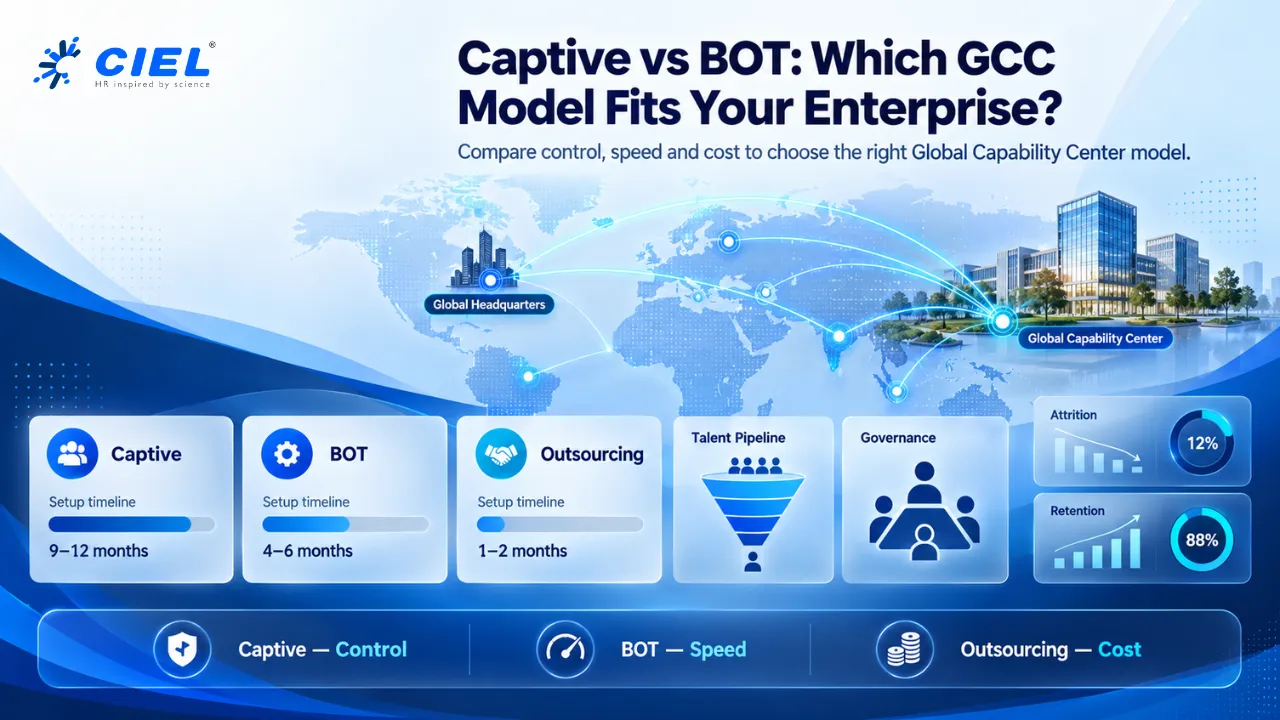
The operating model determines how a GCC integrates with the parent organization and manages operational risk. A captive model provides direct control over hiring and culture, while a BOT arrangement leverages a local partner to establish the facility before transferring ownership. This structural choice directly impacts the speed of deployment and the long-term governance model.
| Feature | Captive Model | Build-Operate-Transfer (BOT) | Traditional Outsourcing |
|---|---|---|---|
| Control & Culture | High alignment with HQ | Medium, transitioning to High | Low, vendor-driven |
| Setup Time | 9 to 12 Months | 4 to 6 Months | 1 to 2 Months |
| Core Focus | Strategic IP & Innovation | Rapid Capability Scaling | Cost Arbitrage & Volume |
What Is the Best Framework for Selecting a GCC Location Beyond Just Cost Arbitrage?
A holistic location strategy balances talent availability, geopolitical stability, and ecosystem maturity rather than relying solely on labor rates. Evaluating a region’s university pipeline and existing industry clusters ensures the facility can sustain long-term growth. This multidimensional framework prevents the common pitfall of establishing a hub in a region that cannot support advanced technical roles.
As a working threshold, organizations should look for a local talent pool where specialized skill availability grows by at least 10% annually. If the regional attrition rate for targeted roles exceeds 20%, the location presents a high operational risk regardless of the initial cost savings. Identifying overlapping time zones for at least four hours of the working day also ensures synchronous collaboration between the parent company and the GCC.
What Are the Key Components of a Successful Talent Acquisition and Retention Strategy for a New GCC?
A comprehensive talent acquisition and retention strategy builds a compelling employee value proposition to attract specialized skills in a competitive GCC market. Aligning local compensation structures with global career progression paths reduces turnover and builds institutional knowledge. This integration ensures the remote team functions as an extension of the core enterprise rather than an isolated support unit.
To retain top performers , the strategy must include active integration into the parent company’s core initiatives. When a GCC operates merely as a cost-saving measure, talent views the roles as stepping stones. When the GCC owns distinct intellectual property and drives global product roadmaps, the facility becomes a destination employer.
How Do You Design an Effective Governance Model to Align a GCC with the Parent Company’s Strategic Goals?
An effective governance model aligns the GCC with the parent company’s strategic goals through shared performance metrics and joint steering committees. Establishing clear Service Level Agreements (SLAs) and cross-border reporting lines prevents operational silos. This alignment ensures the remote facility contributes directly to enterprise objectives rather than operating on disparate priorities.
- Strategic Alignment: Leadership representation <10% = High Risk. Action: Appoint joint steering committee members from both headquarters and the local hub to oversee capacity planning.
- Performance Tracking: Metric divergence >15% = Medium Risk. Action: Unify KPIs across global and local teams to ensure consistent measurement of delivery and quality.
- Operational Autonomy: Decision delay >48 hours = High Risk. Action: Delegate specific budgetary and hiring approvals directly to local site leaders to prevent bottlenecks.
What Are the Trade-Offs of Establishing a Global Capability Center?
Scaling a GCC involves significant upfront capital and management bandwidth compared to traditional outsourcing. Organizations must balance the desire for direct control against the complexity of navigating foreign labor laws and compliance frameworks. Understanding these limitations is critical before committing to a captive or BOT model.
- Not suitable when: The enterprise requires immediate, short-term tactical support without a long-term commitment to developing a regional employment presence .
- Consideration: Maintaining cultural alignment across time zones requires continuous investment in cross-border leadership travel, communication infrastructure, and synchronized operational playbooks.
- Trade-off vs alternative: A captive GCC requires 9 to 12 months of setup time and high initial capital expenditure, whereas traditional vendor outsourcing can be deployed in weeks with near-zero infrastructure investment.
To learn more about structuring your global operations and expanding your international footprint, explore our comprehensive frameworks for capability center deployment.
Frequently Asked Questions
How do you integrate a new GCC with existing enterprise IT infrastructure?
Integrating a GCC requires establishing secure, compliant network gateways and unified identity access management between the parent company and the local hub. Organizations must deploy standard enterprise architecture protocols and align data governance policies before migrating any core workloads to the new facility.
What is the typical timeframe to realize ROI on a captive model?
As a working threshold, organizations plan for a 24- to 36-month breakeven period when deploying a captive model. The initial capital expenditure for real estate, legal entities, and talent acquisition defers immediate cost returns, but the long-term value accelerates once the hub begins delivering proprietary intellectual property.
How does a Build-Operate-Transfer (BOT) mechanism work?
A BOT mechanism leverages a local third-party partner to establish the legal entity, secure real estate, and hire initial staff on behalf of the enterprise. After a predefined operational period, the parent organization executes a transfer clause to assume full legal and operational control of the facility and its employees.
What are the common pitfalls to avoid when scaling a global capability center from a pilot to a large-scale operation?
A primary pitfall is maintaining a vendor-management mindset rather than an integrated organizational culture. When parent companies limit the GCC to low-level execution tasks rather than strategic planning, they fail to attract senior talent , resulting in high attrition and stalled operational maturity.
Beyond cost savings, what are the key metrics to measure the business impact and maturity of a GCC?
Organizations measure GCC maturity through metrics such as the percentage of global product ownership held locally, the ratio of senior architects to junior developers, and the internal promotion rate. High performance in these areas indicates the facility is generating strategic value rather than merely executing delegated tasks.
