

Table of Contents
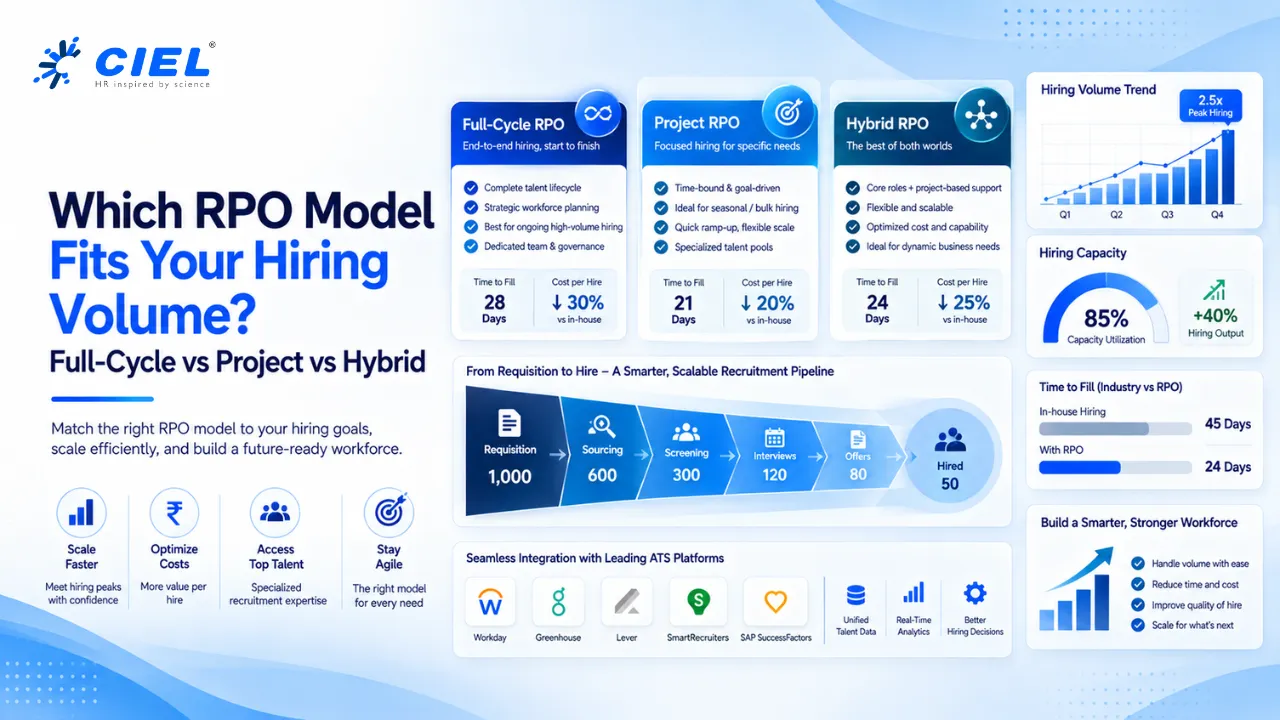
The best Recruitment Process Outsourcing (RPO) model depends on hiring volume predictability. Full-Cycle RPO replaces internal recruiting to manage long-term hiring. Project RPO deploys dedicated recruiters for short-term initiatives. Hybrid RPO integrates external sourcing with internal teams to manage fluctuating requisition loads.
How Do Evaluation Frameworks for RPO Models Fall Short?
Traditional evaluation frameworks for Recruitment Process Outsourcing (RPO) isolate cost per hire without measuring requisition volume variance. This misalignment forces organizations into rigid contracts that either overcharge during hiring freezes or bottleneck during sudden growth phases.
Many talent acquisition directors approach RPO selection by comparing per-requisition fees across vendors. This standard evaluation method fails because it ignores the fundamental architecture of the delivery model. When an organization selects a model based purely on baseline cost rather than operational elasticity, they risk severe pipeline disruption. Evaluating an outsourced hiring solution requires analyzing historical headcount fluctuations alongside internal recruiter capacity to determine the precise level of external integration required.
What Criteria Determine the Right RPO Delivery Model?
The RPO selection framework evaluates historical headcount variance, internal recruiter capacity, and specific timeline constraints to dictate the correct service tier. Aligning the delivery model to these operational realities ensures continuous talent pipelining without unnecessary overhead.
To avoid selecting a misaligned structure, organizations analyze specific operational thresholds. The following criteria serve as a practical evaluation rubric for mapping business requirements to the correct outsourced model:
- Volume Variance: As a working threshold, we recommend treating requisition variance above 20% quarter-over-quarter as high risk for fixed models. Action: Select a hybrid structure to absorb unpredictable peaks.
- Time-to-Fill Requirement: Baseline time-to-fill exceeding 60 days for critical roles signals a failing pipeline. Action: Deploy a project-based engagement for immediate, localized sourcing.
- Integration Capacity: Internal talent acquisition headcount below 2 indicates low capacity for managing shared workflows. Action: Implement a full-cycle model to manage end-to-end processing.
How Does a Misaligned RPO Model Impact Talent Operations?
Selecting an outsourced recruitment model without mapping it to actual volume variance creates immediate operational bottlenecks. When the contract structure prohibits rapid scaling, hiring managers face critical talent shortages during expansion periods.
Illustrative example: A mid-market logistics enterprise signs a Full-Cycle RPO agreement based purely on the lowest projected cost-per-hire. The procurement rubric assumes a steady state of fifty requisitions per month. The talent acquisition director hands over all sourcing tools and operational control to the vendor.
By quarter two, hiring demand spikes to one hundred and fifty open roles due to a new facility launch. The fixed model, governed by strict allocations, does not scale instantly. The internal HR team lacks the infrastructure to step in. Requisitions sit pending for weeks.
The bottleneck delays the facility launch. The enterprise loses major operational capacity. A Hybrid RPO model, evaluated correctly for volume variance, catches this vulnerability immediately. Under a hybrid structure, the internal team maintains core operations while the vendor flexes up to absorb the facility-launch volume. This gap highlights the operational cost of prioritizing baseline unit economics over structural elasticity.
How Do Hybrid and Traditional RPO Approaches Compare?
Hybrid RPO integrates external sourcing capabilities with existing internal HR technology stacks, maintaining corporate control over the employer brand . This approach reduces time-to-fill during volatile hiring periods compared to fully outsourced alternatives.
Understanding the architectural differences between agile and traditional approaches clarifies which model supports specific business objectives. The table below outlines the core operational distinctions.
| Feature | Hybrid RPO (New Approach) | Full-Cycle RPO (Traditional Approach) |
|---|---|---|
| Scalability | Elastic deployment based on requisition volume | Fixed recruiter allocation based on annual projections |
| Technology Integration | Uses existing internal ATS and workflows | Replaces internal systems with vendor platforms |
| Cost Structure | Variable pricing tied to specific project scopes | Fixed monthly management fees plus placement costs |
| Internal TA Role | Retains strategic oversight and core hiring | Absorbed or eliminated by the vendor |
Evaluate your current requisition variance against these thresholds to determine which RPO model aligns with your hiring forecast and operational capacity.
What Are the Trade-offs of Adopting Project RPO?
Project RPO isolates specific hiring initiatives into dedicated, short-term vendor deployments , delivering rapid candidate pipelines for defined roles. While this accelerates immediate hiring, it does not build long-term talent infrastructure for the organization.
- Not suitable when: The organization requires ongoing, continuous hiring across all departments indefinitely to maintain baseline operations.
- Consideration: Requires rapid onboarding of vendor recruiters to understand the specific employer value proposition within a condensed 30-day window.
- Trade-off vs alternative: Project-based engagements carry higher per-placement premiums compared to the amortized cost structure of a multi-year full-cycle agreement.
Select the model that matches your structural reality, then review the technical prerequisites for deployment with your vendor.
Frequently Asked Questions
How do I decide if a hybrid RPO solution is right for my business?
A hybrid model fits organizations that possess a functional internal talent acquisition team but experience unpredictable spikes in requisition volume. It provides structural elasticity, allowing the external vendor to absorb peak hiring phases without requiring the business to replace its core HR infrastructure.
What are the technical prerequisites for integrating an RPO provider?
Integration requires a defined Application Programming Interface (API) gateway or direct administrative access to your existing Applicant Tracking System (ATS) . The organization must also establish clear data governance protocols to ensure candidate records synchronize correctly between the vendor’s sourcing platforms and internal HR databases.
How do you measure the cost-effectiveness and ROI of different RPO delivery models?
ROI measurement requires tracking baseline time-to-fill, agency spend reduction, and quality-of-hire metrics against the vendor’s Service Level Agreement (SLA). Rather than looking solely at the monthly management fee, organizations calculate the operational revenue retained by filling critical roles faster than the historical baseline.
How does a full-cycle RPO mechanism process candidate pipelines?
The vendor assumes total ownership of the hiring workflow, from initial job profiling to final onboarding. They deploy dedicated recruiters who operate under the client’s employer brand, utilizing proprietary sourcing technologies to build, screen, and deliver a continuous pipeline of qualified candidates directly to hiring managers.
How does scalability differ between full-cycle and project RPO services?
Full-cycle agreements scale over long-term, multi-year horizons based on annual corporate growth projections. Project services scale instantly for immediate, short-term deployment, concentrating recruiting resources on a specific initiative with a defined end date, such as a facility launch or seasonal ramp-up.
What are the key differences between full-cycle, project, and hybrid RPO models regarding employer branding?
Full-cycle completely internalizes the brand representation, with vendor recruiters acting seamlessly as company employees. Project deployments often leverage the vendor’s specialized market presence to attract niche talent quickly. Hybrid structures share brand representation, requiring strict alignment between internal HR messaging and external sourcing campaigns.
