

Table of Contents
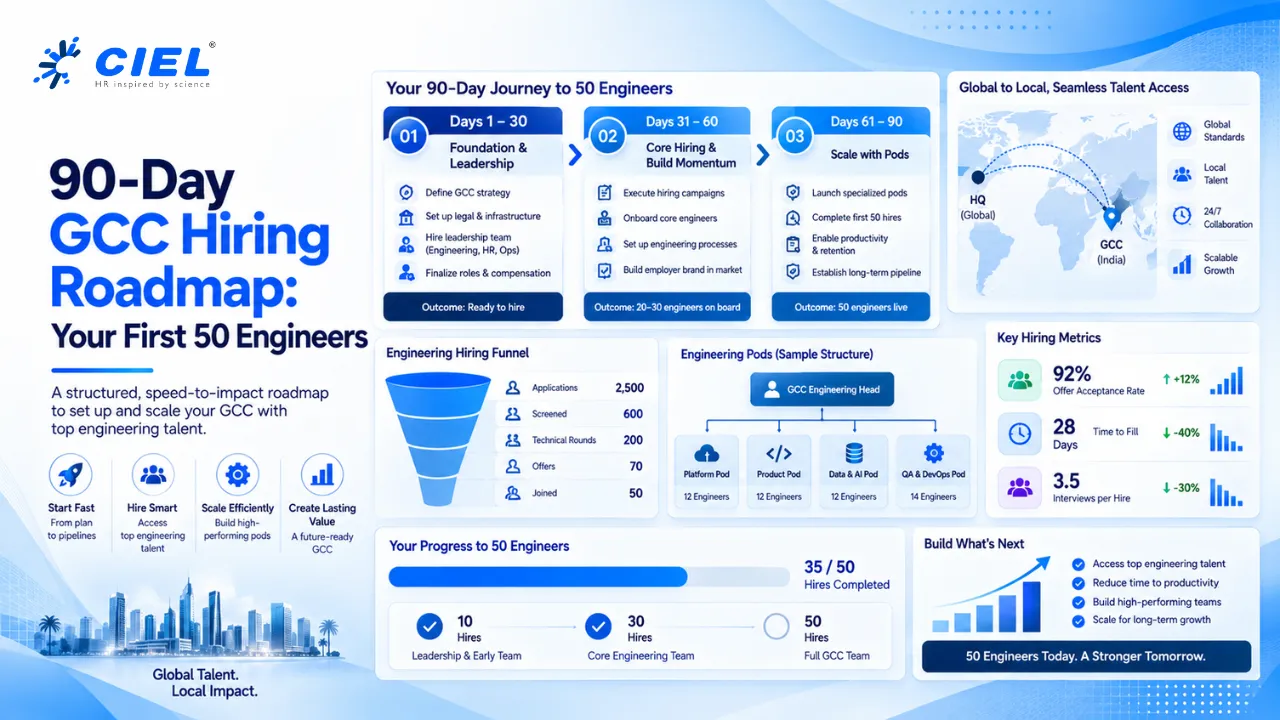
Launching a Global Capability Center (GCC) requires transitioning immediately from site selection to executing a 90-day talent acquisition plan . A structured 90-day GCC hiring roadmap synchronizes targeted employee value propositions with scalable technical interview workflows, enabling site leaders to secure the first 50 engineering hires without exhausting internal evaluators.
What Constraints Determine the Success of a New GCC Launch?
The site leader profile dictates the operational trajectory of a new Global Capability Center. Hiring a leader who functions as a technical architect rather than an operational manager limits cross-functional integration, delaying the first 30 days of a GCC talent acquisition plan.
Determining what is the ideal profile and key responsibilities for the first site leader of a new global capability center establishes the foundation for subsequent hires. The ideal candidate balances engineering credibility with local market procurement expertise. They oversee the localized compensation bands and drive the core messaging for recruitment. Understanding how to craft a compelling employee value proposition for a new GCC to attract senior tech talent requires aligning global engineering standards with localized career progression frameworks, rather than merely translating headquarters’ benefits. Candidates at the senior level demand architectural autonomy; an EVP that promises ownership over microservices rather than legacy maintenance secures higher acceptance rates.
How Do You Execute the 90-Day Implementation Timeline?
A phased 90-day hiring plan segments requisition deployment into leadership, core infrastructure, and application development tiers. This sequential pipeline prevents Applicant Tracking Systems like Greenhouse or Workday from bottlenecking under simultaneous unstructured requisitions.
Identifying what are the critical success factors for the first 30 days of a GCC talent acquisition plan focuses the team on foundational leadership. Days 1 through 30 prioritize hiring the site leader, HR director, and principal engineering managers. Days 31 through 60 shift to senior individual contributors. Days 61 through 90 focus on filling complete Agile structures. When structuring these teams, determining what are the best team structures or pod models for the first 50 engineering hires in a new tech center dictates operational efficiency. A standard independent pod includes one tech lead, three senior developers, and two QA automation engineers.
To support this volume, talent acquisition teams must solve how to design a scalable technical interview process that avoids interviewer burnout during hyper-growth. Implementing asynchronous technical assessments via standardized code-review platforms filters candidates before they reach the live interview stage. This protects the bandwidth of the limited founding engineers, ensuring they only spend time evaluating candidates who have already proven baseline competency.
What Are the Trade-offs of Accelerated GCC Scaling?
Accelerated talent acquisition models prioritize pipeline velocity over deep organizational integration. This approach risks cultural fragmentation if the newly formed engineering pods operate in silos separated from the global headquarters.
- Not suitable when: The core product architecture lacks clear microservices boundaries, requiring constant synchronous collaboration and code merges with the headquarters.
- Consideration: Rapid hiring strains local HR compliance , requiring dedicated legal counsel to manage local employment contracts, tax liabilities, and payroll integrations.
- Trade-off vs alternative: Hiring a dedicated internal recruitment team takes longer to establish initially but yields a lower long-term cost-per-hire compared to relying entirely on external staffing agencies for the first 50 roles.
How Do You Validate ROI and Mitigate Scaling Risks?
Establishing strict recruitment telemetry validates the return on investment for the new tech hub. Tracking offer-to-acceptance ratios provides visibility into market competitiveness, allowing teams to adjust the employee value proposition before pipeline collapse.
To maintain velocity, engineering and talent acquisition leaders must monitor operational thresholds continuously. As a working evaluation heuristic, apply the following diagnostic rules to your recruitment pipeline:
- Offer Acceptance Rate: Rate < 60% = HIGH RISK. Rate > 75% = PASS. Action: Audit the employee value proposition and adjust compensation bands to match current local market data.
- Time-to-Fill: > 45 days for senior roles = HIGH RISK. < 30 days = PASS. Action: Simplify the technical interview process to reduce candidate drop-off and accelerate decision-making.
- Interviewer Load: > 5 hours per week per founding engineer = HIGH RISK. < 3 hours = PASS. Action: Introduce asynchronous technical assessments and strict grading rubrics to eliminate redundant screening calls.
How Does a Structured Hiring Roadmap Compare to Ad-hoc Recruitment?
A structured hiring roadmap standardizes capacity planning against an ad-hoc recruitment model that relies on reactive requisition approvals. This standardization reduces time-to-productivity for the first 50 engineering hires.
| Feature | Structured Hiring Roadmap | Ad-hoc Recruitment |
|---|---|---|
| Requisition Sequencing | Phased deployment (Leadership → Core → Pods) | Simultaneous, reactive job postings |
| Interview Scalability | Asynchronous assessments; strict SLA on feedback | Manual screening; high internal engineering load |
| Offer Drop-out Mitigation | Pre-closing calls; transparent equity alignment | Standard offer letters with delayed negotiations |
| Time-to-Productivity | Optimized; full pods deployed within 90 days | Delayed; incomplete teams block feature delivery |
Ready to execute your expansion strategy ? Deploy this 90-day framework to secure your first 50 engineers efficiently and establish a high-performing Global Capability Center.
Frequently Asked Questions
How do you integrate global HR systems with localized GCC payroll platforms?
Integration requires establishing secure API gateways between the global Applicant Tracking System and the local payroll provider. This ensures compliance with local data residency laws while maintaining centralized visibility into headcount and compensation metrics.
What is the ROI timeframe for establishing a new Global Capability Center?
Initial ROI indicators, such as reduced cost-per-hire and increased engineering output, become measurable within 6 to 9 months of the first 50 hires. Full operational maturity and maximum cost arbitrage are achieved within 18 to 24 months.
How does a scalable technical interview process work mechanically?
A scalable process routes candidates through an automated, asynchronous coding assessment via a standardized platform before any human interaction occurs. Only candidates who pass the baseline algorithmic thresholds advance to live system design interviews, protecting internal engineering bandwidth.
What are the most effective strategies to reduce high offer drop-out rates when launching a new tech hub?
Reducing drop-out rates requires accelerating the offer generation timeline to under 48 hours post-interview and assigning a dedicated technical executive to conduct pre-closing calls. Aligning equity and local benefits transparently during the first screening also prevents late-stage compensation misalignment.
How to mitigate key risks like slow market visibility and talent competition in a 90-day hiring plan?
Mitigate slow visibility by executing targeted employer branding campaigns 30 days before opening requisitions. Counter talent competition by clearly defining the engineering autonomy of the local pods, proving to candidates that the center owns core product architecture rather than legacy maintenance.
What are the best team structures or pod models for the first 50 engineering hires in a new tech center?
The most effective structure utilizes cross-functional Agile pods consisting of one engineering manager, one product owner, three senior backend engineers, two frontend engineers, and one QA automation specialist. This model ensures each unit can ship features independently without headquarters dependencies.
