

Table of Contents
Internal talent acquisition teams often struggle to scale hiring capacity during rapid growth periods. The requisition count multiplies, but the recruiting headcount remains static. The resulting bottleneck delays critical project launches and forces hiring managers to compromise on candidate quality just to fill empty seats.
The standard response is to push more work onto existing recruiters or rely heavily on external contingency agencies. This fragments the candidate experience and creates isolated data silos. Internal recruiters burn out managing administrative tasks instead of building relationships, while contingency agencies prioritize speed over long-term cultural alignment.
Recruitment Process Outsourcing (RPO) integrates an external talent acquisition team directly into a company’s internal HR infrastructure, managing the end-to-end workflow from workforce planning to onboarding, which standardizes the candidate experience and aligns hiring velocity with business objectives.
How Does the End-to-End RPO Workflow Operate?
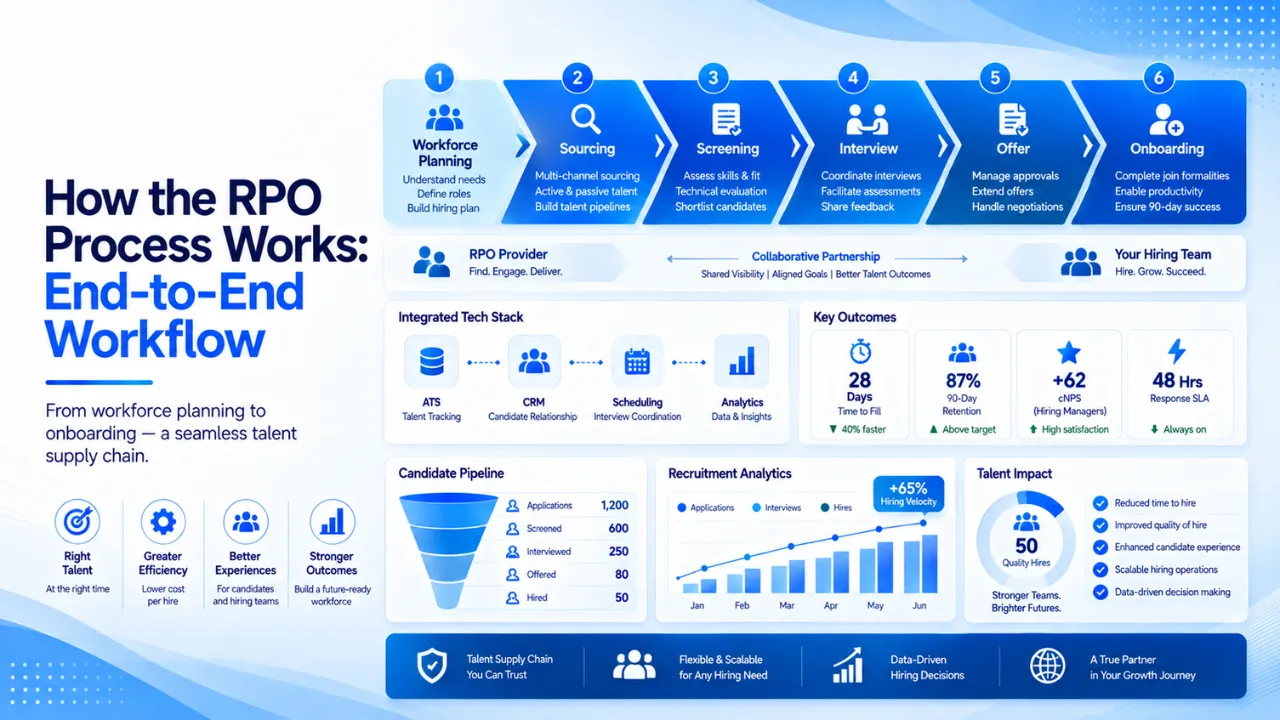
The end-to-end Recruitment Process Outsourcing (RPO) workflow functions as a synchronized talent supply chain, beginning with demand forecasting and concluding with new hire integration. This structured approach eliminates ad-hoc hiring requests and ensures consistent candidate evaluation.
The process initiates with workforce planning , where the RPO team collaborates with internal leadership to forecast hiring needs for the upcoming quarters. Once a requisition opens, the provider executes a predefined sourcing strategy, utilizing market mapping to identify active and passive candidates. The RPO team conducts initial behavioral and technical screenings against an agreed-upon rubric before presenting a curated shortlist to the internal hiring manager.
Following the final interviews, the RPO provider manages the offer extension, background check logistics, and initial onboarding documentation. This continuous workflow prevents candidates from stalling in the pipeline and reduces the administrative burden on internal HR personnel.
What Are the Responsibilities of an RPO Provider Versus the Internal Hiring Manager?
A structured Recruitment Process Outsourcing (RPO) deployment divides responsibilities by assigning pipeline generation to the provider while reserving final selection authority for the internal hiring manager. This division of labor prevents administrative bottlenecks while maintaining internal control over team composition.
At each stage of the hiring process , the boundaries are clearly defined. During the sourcing and screening phases, the RPO provider is entirely responsible for writing job descriptions, launching advertising campaigns, reviewing resumes, and conducting introductory phone screens. The internal hiring manager is entirely removed from this top-of-funnel activity.
The transition occurs at the interview stage. The RPO provider handles all scheduling logistics and candidate communication, while the internal hiring manager conducts the actual interviews to assess technical competency and team fit. When a decision is made, the RPO provider steps back in to negotiate the offer and initiate the onboarding sequence based on the parameters set by the hiring manager.
What Technology Stack Do RPO Providers Typically Use?
Modern Recruitment Process Outsourcing (RPO) providers deploy an integrated technology stack combining Applicant Tracking Systems (ATS), Candidate Relationship Management (CRM) platforms, and automated interview scheduling tools. This infrastructure centralizes candidate data and reduces manual administrative tasks.
Rather than relying on disjointed spreadsheets, RPO providers utilize enterprise-grade platforms such as Greenhouse or Workday to track candidate progression in real time. For outbound sourcing, recruiters leverage platforms like LinkedIn Recruiter alongside specialized CRM software to build talent pools and execute automated, multi-touch email campaigns to passive candidates.
Additionally, the technology stack often includes programmatic job advertising tools that dynamically allocate budget to job boards based on real-time performance data, ensuring maximum visibility for open requisitions without overspending on underperforming channels.
How Is the RPO Process Customized for High-Volume Versus Specialized Roles?
A customized Recruitment Process Outsourcing (RPO) model adjusts its sourcing mechanisms based on role complexity, utilizing automated screening for high-volume hiring and targeted direct outreach for specialized executive positions. This adaptability ensures the cost-per-hire aligns with the strategic value of the role.
When executing a high-volume hiring initiative such as staffing a new customer service center, the RPO provider configures the workflow for speed and scale. This involves deploying chatbot-driven pre-screening questionnaires, hosting virtual hiring events, and utilizing automated assessment tools to rapidly filter hundreds of applicants based on baseline qualifications.
Conversely, filling specialized or executive roles requires a high-touch methodology. The RPO team shifts away from job boards and focuses entirely on market mapping and direct headhunting. Recruiters engage in personalized networking, evaluating a small pool of highly qualified passive candidates through in-depth competency interviews before presenting a highly vetted shortlist of three to four individuals to the hiring manager.
How Does Integration Work Between an RPO Partner and Existing HR Teams?
Integration between a Recruitment Process Outsourcing (RPO) partner and an internal HR team requires establishing shared communication channels, unified reporting dashboards, and synchronized access to internal HR Information Systems (HRIS). This connectivity prevents data fragmentation and ensures a seamless transition during candidate handoffs.
The communication workflow is established during the initial implementation phase. The RPO team is granted role-based access to the company’s internal communication tools, operating under the client’s email domain to maintain a unified brand presence in the market. Regular operational cadences are instituted, including weekly pipeline reviews with hiring managers and monthly strategic alignment meetings with HR leadership.
To maintain data integrity, the RPO provider operates directly within the client’s ATS or establishes a bi-directional API sync between their proprietary systems and the client’s HRIS. This ensures that the internal HR team retains full visibility into the talent pipeline and owns the historical candidate data.
What Are the Key Performance Indicators Used to Measure RPO Success?
Recruitment Process Outsourcing (RPO) performance is evaluated using standardized Key Performance Indicators (KPIs) such as time-to-fill, candidate net promoter score (cNPS), and 90-day retention rates. These metrics shift the evaluation focus from mere activity volume to long-term business impact.
Time-to-fill and time-to-present measure the velocity of the sourcing engine, tracking how quickly a qualified shortlist is delivered to the hiring manager. However, velocity alone is insufficient. Quality of hire is measured through first-year retention data and hiring manager satisfaction scores.
As a prescriptive threshold, organizations should target a 90-day retention rate above 85% to indicate strong candidate-to-role alignment. Additionally, candidate experience is actively measured through post-interview surveys, ensuring the RPO provider acts as a positive ambassador for the employer brand.
How Does an RPO Provider Ensure a Positive Candidate Experience?
A proactive Recruitment Process Outsourcing (RPO) provider maintains a positive candidate experience by enforcing strict communication Service Level Agreements (SLAs) and providing transparent feedback loops throughout the recruitment lifecycle. Consistent engagement prevents candidate drop-off in highly competitive talent markets.
Candidate experience deteriorates rapidly when applicants enter a communication void. To prevent this, the RPO workflow incorporates automated status updates and scheduled touchpoints. As a working baseline, providers establish a 48-hour maximum response SLA for candidate inquiries and interview feedback.
Furthermore, the RPO team prepares candidates extensively before internal interviews, briefing them on the company culture, the interview panel’s background, and the specific competencies being evaluated. This preparation reduces candidate anxiety and allows them to present their qualifications effectively, ensuring the RPO provider acts as a positive ambassador for the employer brand .
What Are the Trade-offs of Adopting an RPO Model?
Implementing a Recruitment Process Outsourcing (RPO) model requires relinquishing direct control over early-stage pipeline generation, which can cause initial friction for organizations accustomed to micro-managing every recruiter interaction. Understanding these limitations is necessary for a successful deployment.
- Not suitable when: The organization hires fewer than 15-20 corporate roles annually, making the integration overhead and implementation effort disproportionate to the hiring volume.
- Consideration: Requires significant upfront investment in aligning employer branding, standardizing interview rubrics, and configuring system permissions before the provider can begin active sourcing.
- Trade-off vs alternative: RPO requires a longer implementation timeline (typically four to eight weeks for full integration) compared to the immediate, albeit highly transactional, start of contingent search agencies.
How Does the Active RPO Model Compare to Traditional Contingency Search?
Evaluating a Recruitment Process Outsourcing (RPO) model against traditional contingency search reveals fundamental differences in pipeline ownership, pricing structures, and long-term talent strategy. This comparison highlights why strategic workforce planning requires dedicated infrastructure.
| Feature | Recruitment Process Outsourcing (RPO) | Traditional Contingency Search |
|---|---|---|
| Pipeline Ownership | Client owns all generated candidate data | Agency owns the candidate data |
| Pricing Structure | Predictable monthly management fee | Transactional percentage of starting salary |
| Candidate Exclusivity | Candidates are sourced exclusively for the client | Candidates are shopped to multiple employers |
| Strategic Alignment | Integrated with internal workforce planning | Reactive to immediate open requisitions |
Illustrative example: A regional healthcare network faces a critical staffing shortage across three outpatient clinics. The internal HR director posts the open nursing requisitions on standard job boards and alerts three contingency agencies. Over the next three weeks, the internal team receives dozens of resumes. Most lack the required state licensure, and the contingency agencies submit the same five candidates simultaneously, triggering a dispute over representation rights. The hiring managers spend six hours a week reviewing unqualified profiles, while the clinics operate at reduced capacity. The existing nurses work mandatory overtime, leading to resignations. The requisition exists, but the strategic sourcing capability does not.
The dynamic shifts entirely under an integrated Recruitment Process Outsourcing (RPO) deployment . When the network projects a capacity increase for the upcoming quarter, the RPO team initiates market mapping 60 days in advance. They deploy targeted programmatic advertising to passive candidates holding the specific state licensure. Instead of a flood of unfiltered resumes, the internal hiring manager receives a curated shortlist of four pre-screened candidates, complete with verified credentials and completed initial behavioral assessments. The manager conducts final interviews and selects two candidates within eight days. The clinics maintain full capacity without burning out the existing staff. To explore how structured talent acquisition frameworks align with long-term business objectives, review our resources on workforce planning and recruitment scalability.
Frequently Asked Questions
What are the technical prerequisites for integrating an RPO provider?
Integrating a Recruitment Process Outsourcing (RPO) provider requires establishing secure role-based access controls within your existing HRIS and ATS platforms . The provider needs API access or dedicated seats in systems like Workday or Greenhouse to manage candidate data without creating isolated data silos.
How is the ROI of an RPO engagement measured?
ROI for a Recruitment Process Outsourcing (RPO) engagement is calculated by comparing the total cost of the RPO contract against the combined expenses of internal recruiter salaries, job board subscriptions, and contingency agency fees, factored against the reduction in time-to-fill and early attrition rates.
What mechanism does an RPO use to source passive candidates?
A Recruitment Process Outsourcing (RPO) provider uses market mapping and programmatic advertising to identify professionals who are not actively applying for jobs. Recruiters then use targeted Candidate Relationship Management (CRM) workflows to engage these individuals with personalized outreach.
Does an RPO provider make the final hiring decision?
No. A Recruitment Process Outsourcing (RPO) provider manages the pipeline, conducts initial screenings, and coordinates interviews. The internal hiring manager always retains the authority to evaluate technical competency, assess cultural alignment, and make the final hiring decision.
How long does it take to implement an RPO solution?
As a working baseline, a full Recruitment Process Outsourcing (RPO) implementation requires four to eight weeks. This period is used to align employer branding, configure technology integrations, establish communication SLAs, and train the dedicated sourcing team on the company’s specific evaluation rubrics.
