

Table of Contents
Growing companies inevitably hit an operational wall where hiring volume outpaces internal capacity. This mismatch turns talent acquisition into a reactive scramble rather than a strategic advantage.Internal teams become buried under administrative tasks such as screening resumes, scheduling interviews, and managing job boards. This leaves no time for strategic pipeline building or employer branding , causing critical roles to remain vacant and stalling broader business expansion initiatives.
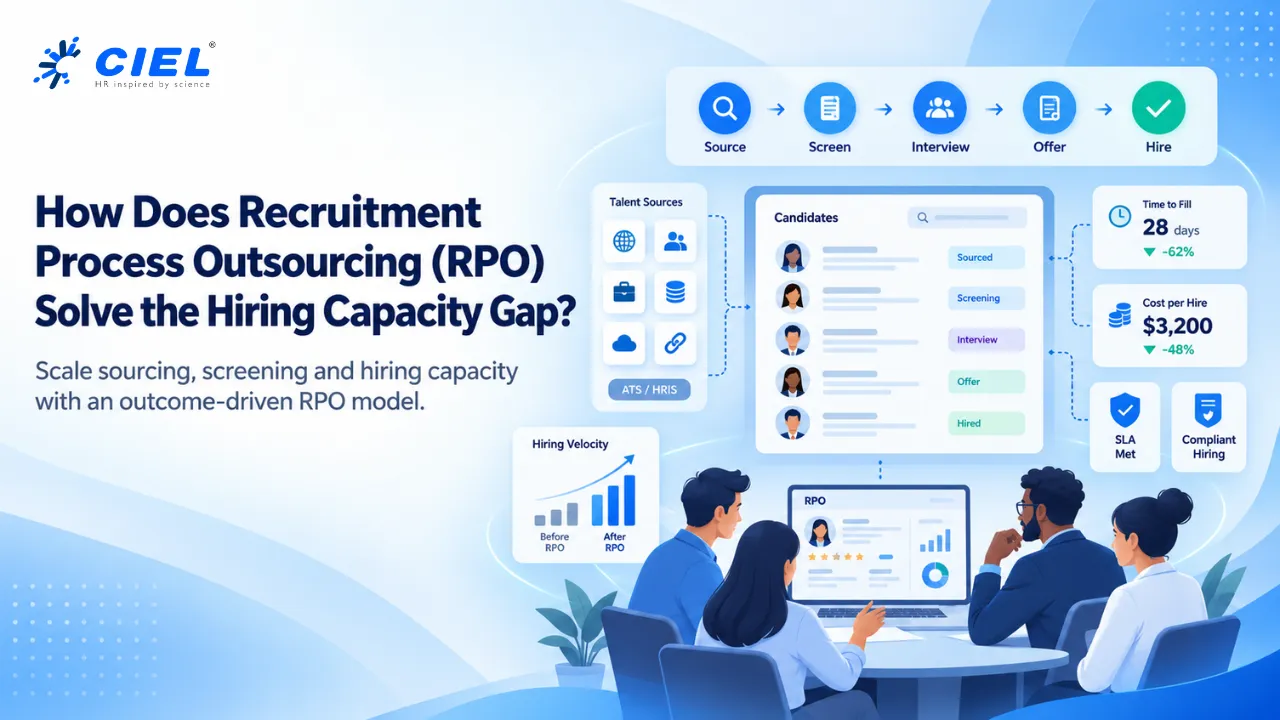
Recruitment Process Outsourcing (RPO) integrates an external talent acquisition team directly into a company’s operational structure, managing the end-to-end hiring cycle to stabilize candidate flow and reduce time-to-fill.
Why Do Traditional Staffing Models Fail Growing Businesses?
Traditional staffing agencies operate on contingency models that prioritize transactional placements over long-term workforce alignment. This reactive approach creates friction with internal culture and inflates cost-per-hire during high-volume growth phases.
In-house HR teams lack the dedicated sourcing tools and bandwidth to manage sudden requisition spikes effectively. When a growing business relies on external contingency recruiters, they pay steep premiums for individual placements without building any proprietary talent pools. Furthermore, traditional agencies prioritize speed over strategic fit, utilizing their own disjointed databases rather than integrating with the company’s Applicant Tracking System (ATS), such as Workday or Greenhouse. This disconnect fragments the candidate experience and leaves the core business wholly dependent on external vendors for every new phase of growth.
How Does Recruitment Process Outsourcing Actually Work?
Recruitment Process Outsourcing (RPO) transfers the complete talent acquisition function right from workforce planning to onboarding to a dedicated external partner operating under the company’s brand. This structural integration standardizes the candidate experience and centralizes hiring data for predictive analytics.
Unlike traditional agencies, an RPO provider embeds its recruiters, technology, and methodologies directly into the client organization. They assume accountability for the entire hiring pipeline under a defined service level agreement (SLA). The deployment scales according to business needs, utilizing different RPO models to match operational maturity. End-to-end RPO assumes full ownership of the hiring pipeline across the enterprise, while project-based RPO targets specific expansion initiatives or localized hiring sprints without disrupting the existing internal HR infrastructure.
What Does an RPO Deployment Look Like in Practice?
Illustrative example:
A regional healthcare network struggles to staff three new outpatient clinics simultaneously. The internal HR department posts requisitions on generic job boards, screens applications manually, and attempts to coordinate interviews alongside daily employee relations duties.
After four weeks, critical nursing and administrative roles remain vacant, delaying clinic openings and straining existing staff who are forced to cover the gaps. The internal team is overwhelmed by the sheer volume of screening required to find credentialed candidates in a highly competitive labor market. The gap between the required hiring velocity and internal capacity brings the expansion project to a halt.
An integrated RPO team steps into the workflow, deploying a dedicated sourcing pod that operates entirely within the healthcare network’s internal ATS environment . The RPO partner implements automated credential verification and localized talent pooling, actively engaging passive candidates rather than waiting for inbound applications. Within the first operational sprint, the dedicated team clears the screening backlog, standardizes interview rubrics, and fills the required clinic rosters two weeks ahead of the revised launch date.
The internal HR team regains its focus, while the hiring pipeline operates as a continuous, scalable engine.
How Do RPO Solutions Compare to Traditional Staffing?
Evaluating talent acquisition strategies requires comparing the structural integration and cost predictability of RPO against the transactional nature of traditional staffing agencies. This comparison highlights how different models impact long-term workforce planning.
| Feature | Recruitment Process Outsourcing (RPO) | Traditional Staffing Agency |
|---|---|---|
| Operational Model | Integrated, process-driven management | Contingency-based, transactional placements |
| Cost Structure | Predictable management or SLA-based fees | High percentage fee per successful hire |
| Tech Stack Integration | Utilizes enterprise ATS (e.g., Workday) | Uses external, proprietary agency databases |
| Candidate Experience | Branded seamlessly as the employer | Branded as the external staffing agency |
| Strategic Focus | Long-term pipeline building and analytics | Immediate role fulfillment and rapid placement |
What Are the Key Signs a Business Needs an RPO Partner?
Identifying the operational tipping point for external talent acquisition requires auditing internal hiring metrics against projected growth targets. Establishing clear thresholds prevents companies from scaling inefficient processes.
To determine readiness for Recruitment Process Outsourcing, evaluate current operations against these baseline thresholds:
- Requisition Volume: >50 open roles annually = HIGH NEED. <20 open roles = LOW NEED. Action: Transition to RPO if volume exceeds internal capacity to maintain quality.
- Time-to-Fill : >45 days average = HIGH RISK. <30 days = PASS. Action: Implement RPO sourcing pods to reduce pipeline bottlenecks.
- Cost-Per-Hire: >25% increase year-over-year = HIGH RISK. Action: Audit agency spend and consolidate under a predictable RPO pricing model.
- ATS Utilization: Manual data entry required across >50% of the candidate journey = HIGH RISK. Action: Deploy RPO to optimize Workday or Greenhouse workflows.
- Compliance Alignment: Data handling deviation from SOC 2 or EEOC guidelines = HIGH RISK. Action: Standardize candidate data management through an RPO governance framework.
What Are the Trade-offs of Implementing an RPO Model?
While Recruitment Process Outsourcing scales hiring capacity, it demands significant upfront integration and relinquishing direct control over daily sourcing activities. Understanding these operational boundaries ensures the model aligns with organizational maturity.
- Not suitable when: The organization hires fewer than 20 distinct roles annually, making the integration overhead of an end-to-end RPO model disproportionate to the required hiring volume.
- Consideration: Establishing an RPO partnership requires a comprehensive audit of existing employer branding, compensation bands, and ATS architecture before the external team begins sourcing.
- Trade-off vs alternative: RPO requires a longer initial setup phase and deeper operational transparency compared to the immediate, albeit more expensive, candidate delivery of a traditional staffing agency.
Exploring a transition from reactive recruiting to strategic talent acquisition requires a clear understanding of your current baseline. Evaluate your internal hiring metrics and consider how a scalable framework might align with your long-term growth objectives.
Frequently Asked Questions
What are the technical prerequisites for integrating an RPO provider?
Deploying Recruitment Process Outsourcing requires secure access provisioning to the organization’s Applicant Tracking System (ATS), such as Greenhouse or Workday. The internal IT and HR teams must establish data sharing protocols and compliance guardrails, such as SOC 2 alignment, to ensure candidate data moves securely between the RPO team and internal stakeholders.
How do you measure the success and ROI of an RPO partnership?
The return on investment for an RPO partnership is measured by tracking reductions in overall cost-per-hire, decreases in average time-to-fill, and improvements in candidate retention rates at the one-year mark. By consolidating fragmented agency spend into a predictable service level agreement (SLA), organizations establish a clear financial baseline to evaluate the partnership’s efficiency.
How does an RPO model improve the overall candidate experience?
Recruitment Process Outsourcing standardizes candidate communication by operating entirely under the client’s employer brand. This unified approach eliminates the disjointed hand-offs typical of third-party agencies, ensuring candidates receive consistent messaging, timely interview feedback, and a seamless transition from the initial screening phase into formal onboarding.
Can a growing business use project-based RPO instead of an end-to-end solution?
Yes, organizations facing localized hiring spikes or launching specific departmental expansions utilize project-based RPO. This model applies the dedicated sourcing and screening mechanisms of full RPO to a contained scope, allowing companies to scale hiring capacity temporarily without committing to an enterprise-wide overhaul of their talent acquisition function.
What strategic advantages does RPO offer for long-term talent acquisition?
Beyond filling immediate vacancies, an RPO partner builds proactive talent pools and analyzes labor market data to inform future workforce planning . This shifts the organization’s talent acquisition strategy from a reactive, requisition-driven process to a predictive model that aligns hiring capabilities directly with long-term business expansion goals.
