

Table of Contents
Global Generalist vs Boutique Executive Search: Coverage, Speed, and Off-Limits Trade-offs
When evaluating global generalist versus boutique executive search, the decision hinges on structural candidate access. A boutique search firm operates with fewer client conflicts, enabling broader talent mapping across direct competitors without triggering off-limits restrictions. Global generalist firms provide established cross-border infrastructure and standardized assessment frameworks, making them preferable for high-volume, multi-region executive deployments.
What Evaluation Question Must Talent Leaders Answer First?
Executive talent acquisition requires aligning the search firm’s structural constraints with the specific hiring mandate. Evaluating a partner based solely on brand recognition obscures the mechanical limitations of non-solicitation agreements. The evaluation determines the candidate pool before the search begins.
Many organizations default to the largest global agencies under the assumption that size equates to candidate access. This common evaluation approach fails because it ignores the mechanical reality of the search industry: candidate access is inversely proportional to a firm’s client roster. When a firm places an executive, that client organization becomes “off-limits” for future recruitment, directly blocking access to its talent pool. A massive global client base mechanically restricts the agency from sourcing candidates from those exact companies.
What Criteria Separate Effective Search Partnerships From Ineffective Ones?
A structured evaluation framework isolates candidate access, execution speed , and partner-level engagement as the primary filters for search firm selection. Applying these criteria prevents misalignment between the mandate’s requirements and the firm’s structural capabilities. Clear evaluation criteria expose operational bottlenecks early.
Effective evaluation tests three specific mechanical constraints. First, review the firm’s off-limits protocol against your target competitor list. A firm with 50 active clients in your specific sector cannot legally recruit from those 50 companies under the ethical guidelines set by bodies like the Association of Executive Search and Leadership Consultants (AESC). Second, assess the retained fee structure and resource allocation model to determine who executes the talent mapping—the senior partner pitching the business, or a junior research associate. Finally, evaluate the cross-border search capability. If the mandate requires sourcing a candidate in Europe for a North American headquarters, the firm must possess localized entity structures and compliance frameworks in both jurisdictions.
How Do Structural Constraints Impact an Active Executive Search?
Selecting a search partner without mapping their structural constraints directly dictates which candidates enter the pipeline. A mismatched firm filters out top-tier talent due to internal compliance rules rather than candidate qualification. The outcome is a compromised shortlist.
Illustrative example: A mid-market enterprise software company initiates a search for a Chief Revenue Officer to lead its expansion into the European market. The board’s search committee defaults to a tier-one global generalist firm, assuming the agency’s massive international footprint guarantees the deepest possible talent pool. They sign the retained fee agreement and wait for the initial candidate slate.
Three weeks into the engagement, the lead partner presents a shortlist that completely omits executives from the top three competing SaaS platforms. When the board questions the omission, the partner explains that those three competitors are existing global clients of the firm’s broader HR consulting division. The firm’s strict internal off-limits policy legally prevents them from soliciting any talent from those organizations. The search committee assumed size meant access, but in this specific vertical, the firm’s size created a mechanical blockade.
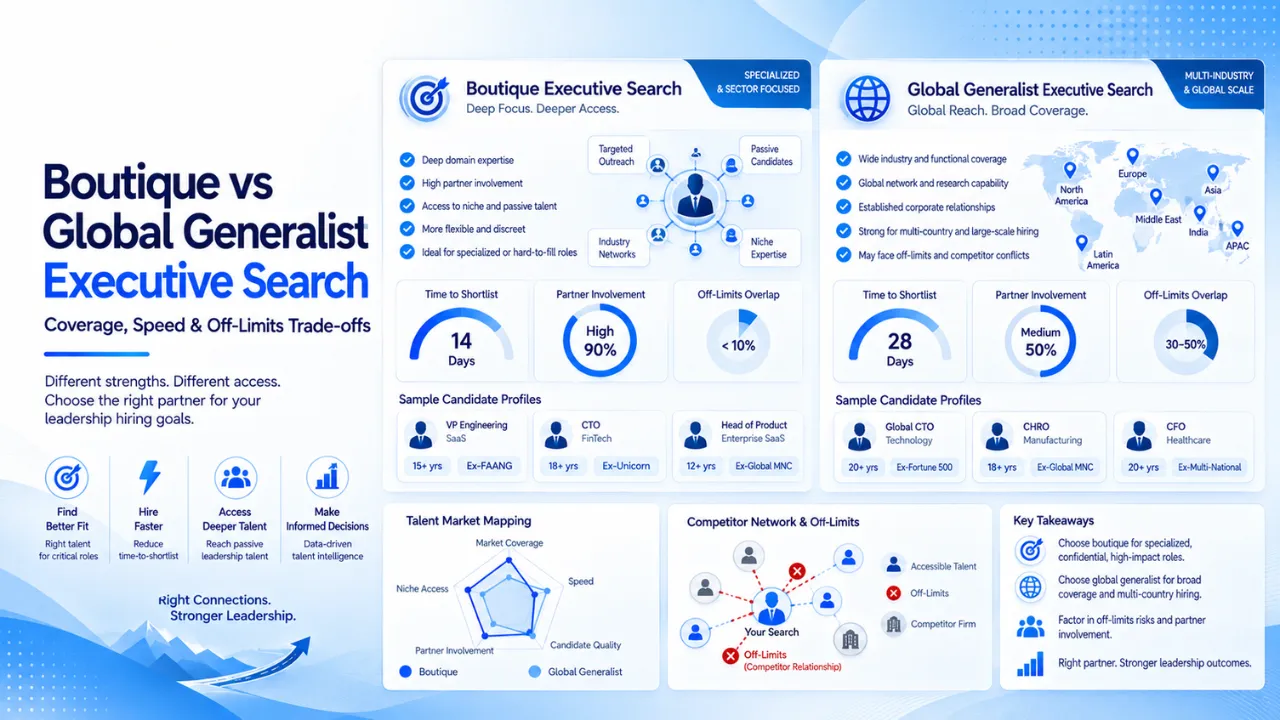
Had the committee evaluated the structural constraints beforehand, they would have engaged a specialized boutique firm . A boutique software-focused agency, lacking those specific enterprise client conflicts, targets the exact competitors the board wanted to poach from. The boutique delivers a shortlist directly from the target organizations within 14 days, bypassing the conflict-check delays of the larger agency. The evaluation criteria dictate the available talent pool long before candidate outreach begins.
How Does a Boutique Firm Compare to a Global Generalist?
A side-by-side analysis of boutique and global generalist models reveals distinct operational trade-offs in candidate sourcing and execution speed. Comparing these structures allows procurement teams to align the search vendor with the specific executive mandate. The correct choice depends entirely on the scope of the hire.
| Feature | Boutique Executive Search | Global Generalist Firm |
|---|---|---|
| Off-Limits Restrictions | Minimal; narrow client base allows broad competitor targeting | High; large client rosters block access to major talent pools |
| Execution Speed | Faster shortlist generation due to fewer internal conflict checks | Slower initial mapping due to complex global compliance protocols |
| Cross-Border Capability | Relies on external affiliate networks for international reach | Native infrastructure and wholly-owned global offices |
| Senior Partner Involvement | End-to-end execution by the primary relationship holder | Pitch by senior partner, execution delegated to associates |
| Fee Structure | Retained model, often with milestone-based flexibility | Standardized retained model with rigid billing schedule |
Operational Authority Matrix
To determine which model fits a specific mandate, apply this prescriptive evaluation rubric:
- Off-Limits Overlap: Condition: Target candidate pool overlap > 20% with the firm’s existing client list = HIGH RISK. Action: Request an explicit off-limits disclosure list before signing the retained agreement.
- Partner Execution Ratio: Condition: Dedicated partner execution time < 70% of total sourcing hours = HIGH RISK. Action: Mandate a Service Level Agreement (SLA) for senior partner involvement in all candidate interviews.
- Jurisdictional Complexity: Condition: Mandate requires placement across > 2 regulatory jurisdictions = LOW FIT for a single-office boutique. Action: Require proof of localized compliance frameworks or select a global generalist.
What Are the Trade-Offs of Engaging a Specialized Boutique?
Selecting a boutique search agency introduces specific limitations regarding international scale and standardized corporate governance. Evaluating these trade-offs ensures the organization does not outgrow the search partner’s mechanical capabilities. Understanding the limitations prevents mid-search vendor replacement.
- Not suitable when: The mandate requires simultaneous executive placements across four or more global regions, requiring consolidated vendor management and unified centralized billing.
- Consideration: Boutique firms lack the massive proprietary historical databases maintained by global generalists, relying instead on real-time talent mapping and external intelligence gathering.
- Trade-off vs alternative: Using a boutique provides higher senior-level attention and fewer off-limits blocks, but sacrifices the single-vendor simplicity and standardized assessment frameworks native to a global generalist.
What Determines the Long-Term Success of a Talent Partnership?
Building a long-term strategic talent partnership requires aligning the search firm’s growth model with the hiring organization’s geographic and vertical expansion plans. A mismatched partnership limits future executive pipeline development. The firm’s architecture must scale alongside the client’s needs.
A global generalist serves well when a multinational corporation needs a single vendor for hundreds of leadership roles across diverse functions. A boutique excels when an organization needs a deep, continuous pipeline within a highly specialized niche . To evaluate your specific organizational needs against these models, review your upcoming executive roadmap and map it against potential off-limits restrictions.
Map your executive talent requirements against our vendor evaluation framework to determine the optimal search model for your next mandate .
Frequently Asked Questions
What are the typical fee structure differences between a large global search firm and a smaller boutique agency?
Both models operate on a retained fee structure, typically charging a percentage of the executive’s first-year compensation. Global generalists enforce rigid billing schedules tied to fixed calendar intervals. Boutique agencies frequently offer milestone-based billing, tying payments directly to deliverables like shortlist presentation and final candidate acceptance.
For hiring a highly specialized C-level role, is a boutique or a generalist search firm more effective?
A specialized boutique firm is mechanically better suited for niche C-level roles. Their narrow focus means they already map the specific talent pool and maintain active relationships with passive candidates in that vertical, whereas a generalist firm must build the talent map from scratch for each specialized mandate.
How does senior partner involvement differ when working with a boutique vs a large executive search firm?
In a boutique model, the senior partner who pitches the business executes the talent mapping and conducts the candidate interviews. In a global generalist model, senior partners manage client relationships while delegating the actual candidate identification and initial outreach to junior research associates.
How do off-limits restrictions at large search firms limit the available candidate pool?
Search industry standards dictate that a firm cannot recruit from an organization it currently serves. Because global generalists maintain massive client rosters across multiple divisions, vast segments of the talent market become legally restricted, blocking access to executives at direct competitors.
What are the technical prerequisites for integrating a search firm into an internal talent acquisition system?
Integrating external search data requires the firm to support secure API or flat-file data transfers compliant with your internal HRIS or Applicant Tracking System . The firm must output candidate profiles, interview scorecards, and background check telemetry in standardized JSON or XML formats to prevent manual data entry bottlenecks.
What are the main pros and cons of using a boutique executive search firm for a cross-border search?
The primary advantage is speed and access to niche regional talent without off-limits conflicts. The main disadvantage is a lack of native corporate infrastructure in foreign jurisdictions, meaning the boutique must rely on external affiliate networks to handle localized compliance and contract formatting.
