

Table of Contents
Why Employee Retention Starts Before Day One
Picture two candidates accepting the same job, on the same day, at the same salary. Six months later, one is thriving. The other has already updated their resume to reflect their onboarding experience. What separates these two people usually has nothing to do with what happened after they clocked in for the first time. It has everything to do with what happened before that.
For staffing and recruitment agencies, this gap is a margin problem. Every early exit means another search, another round of interviews, and another placement to justify to a client who is still wondering why the last candidate didn’t work out.
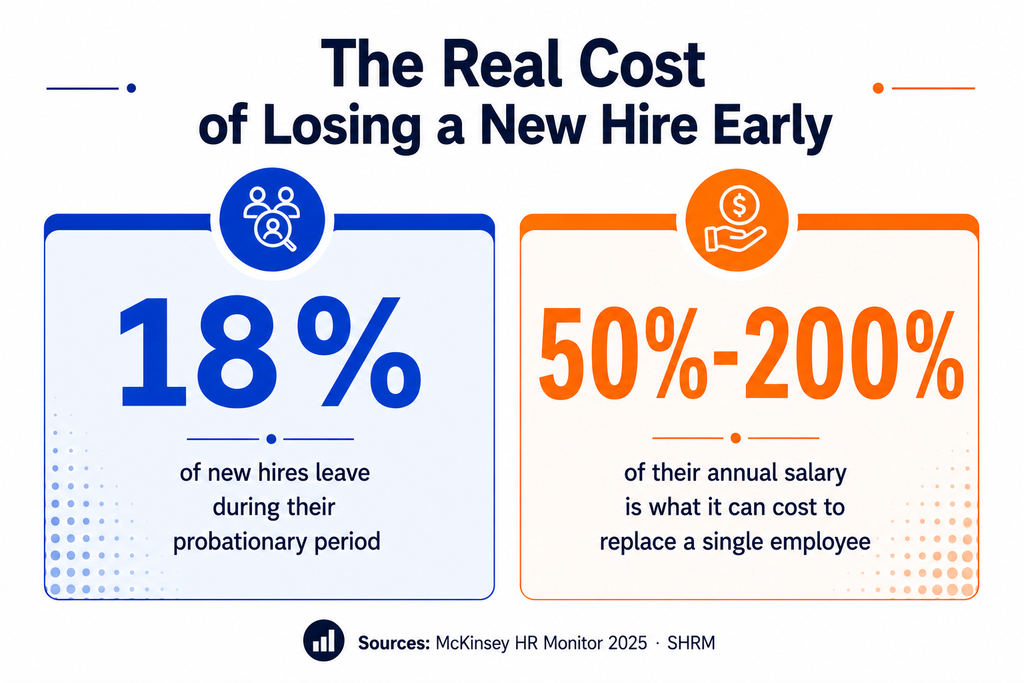
[Alt Text: Graphic explaining the real cost of losing a hire early.]
It Starts Before They Ever Apply
Employee retention doesn’t begin on a person’s first day; the foundations are laid before they even take an interview.
Candidates Are Already Forming an Opinion Before the Interview
They’re reading reviews, scrolling the company’s social media, and sizing up the person who might become their manager. Every touchpoint along the way, good or bad, shapes what they expect from the job before they’ve worked a single billable hour.
A Confusing or Impersonal Hiring Process Is Itself a Preview
The hiring process tells a candidate exactly what to expect from the relationship, and it’s not flattering. An organized, honest one builds trust before the job even begins. That means the boring logistics too: where to park, which door to use, who they’re meeting, what to wear, and what tech they’ll need if the interview is virtual.
A Bad Hire Is Expensive
A wrong hire can mean one to two months of time and money gone before you even factor in a replacement bill that can run from 50% to 200% of that person’s annual salary, according to SHRM.
A Job Is an Agreement, and Mismatched Agreements Fall Apart
The employer offers a role, a schedule, a work environment, and a clear sense of how success will be measured, whereas the candidate brings skills, availability, and honesty about their own limitations, whether that’s transportation, scheduling constraints, or experience gaps.
Turnover often happens simply because the two sides quietly signed different contracts in their heads. It’s far better for a candidate to realize during an interview that a role isn’t the right fit than to realize it three weeks in, when a client is already counting on them to show up.
Overselling the Job to Fill It Fast Backfires
Painting an unrealistically rosy picture might get someone in the door, but it doesn’t build a committed team. It just delays the disappointment to week two. Or worse, week four.
Scheduling Surprises Break Trust Fast
Staffing agencies feel this acutely, since client-driven schedule shifts come with the territory. If a role is advertised as 30 hours a week or fully remote, don’t let the new hire discover otherwise on day three. Business needs can shift, and that’s fine, but say so before the decision is made, not after.
Even Payroll Accuracy Plays a Role
Just two payroll mistakes are enough to send nearly half of employees job-hunting again, which makes clean time tracking as much a retention tool as an operational one.
6 Ways to Prevent Early Turnover
Once you know a large portion of retention gets decided before day one, the fix is less about grand gestures and more about a repeatable process instead of winging it every time. A few things that consistently move the needle:
- Hire Slowly and Use More Than One Touchpoint
About 18% of new hires leave during their probationary period, often because the job’s expectations didn’t match what was set during hiring. Two or three interviews per role gives both sides real time to spot genuine alignment before an offer goes out, not after.
- Keep Interview Logistics Simple
Candidates are already nervous about where to go and who they’re meeting, so clear instructions upfront let the conversation focus on fit and clarity.
- Keep a Simple, Repeatable Hiring Checklist
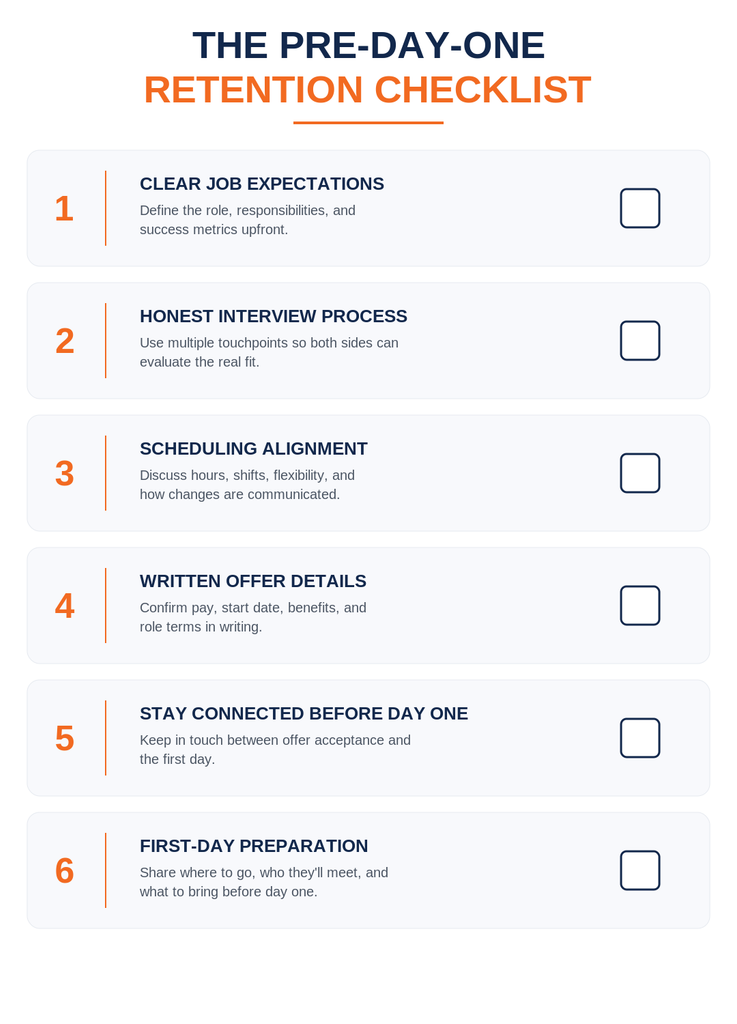
It doesn’t need to be fancy. One document covering job expectations, interview communication, scheduling, candidate follow-up, offer details, pre-boarding, and first-day prep is usually plenty, as long as it gets used for every hire and not just the ones that feel important.
- Stay in Touch Between Offer and Start Date
A new hire who’s already said yes shouldn’t be left wondering if the job is still real. Confirming the start date, arrival time, required documents, equipment, and who they’ll meet on day one costs nothing and kills the awkward silence that makes people second-guess an accepted offer.
- Don’t Ghost Candidates, Even the Ones You Don’t Hire
Technology makes it easy to respond at scale, even with hundreds of applicants in the pipeline. A short, respectful message beats radio silence every time, and the person who isn’t right for today’s role might be right for the next one.
- Treat Every Candidate Like a Person, Not a Line Item
That mindset is the glue that keeps a repeatable process from decaying into a checkbox exercise nobody actually follows.
Employee Retention Is Built on Trust
Trust doesn’t announce itself when it’s working. Nobody sends a thank-you note for an accurate schedule or an honest job description. Trust only becomes visible in its absence, in the awkward first week, the surprise resignation, the exit interview that reveals a promise that never got kept. By then, the cost has already been incurred.
What’s easy to miss is that trust compounds, in both directions. Candidates talk. The ones who aren’t hired tell others how they were treated. The ones who leave early explain why, whether anyone asks or not. In a market where referrals and reputation move faster than any job posting, every hiring decision either adds to that reserve or quietly draws it down.
None of this requires expensive software or a bigger team. It just takes treating every promise made during hiring, about the role, the schedule, the pay, and the process, as something that has to hold up later. That’s a habit, and it’s the only kind of retention strategy that keeps paying off long after any single hire has come and gone.
About the Author:
Dean Mathews is the Founder, CEO, and Product Director of OnTheClock, an employee time clock and payroll app he built to help small businesses manage their teams with greater simplicity and confidence. Today, OnTheClock serves more than 16,000 businesses and 160,000 employees through an integrated platform for employee time tracking, scheduling, paid time off, and payroll.
With more than 20 years of experience in the software-as-a-service industry, Dean has dedicated his career to building innovative products that solve real-world problems. He is equally passionate about creating a workplace where people feel supported, empowered, and able to reach their full potential.
A self-taught builder driven by curiosity and purpose, Dean believes the foundation of every successful business is its people, including their talent, passion, and potential.
When he is not perfecting time tracking, Dean enjoys expanding his faith, spending time with family and friends, and finding ways to make the world just a little better.
