

Table of Contents
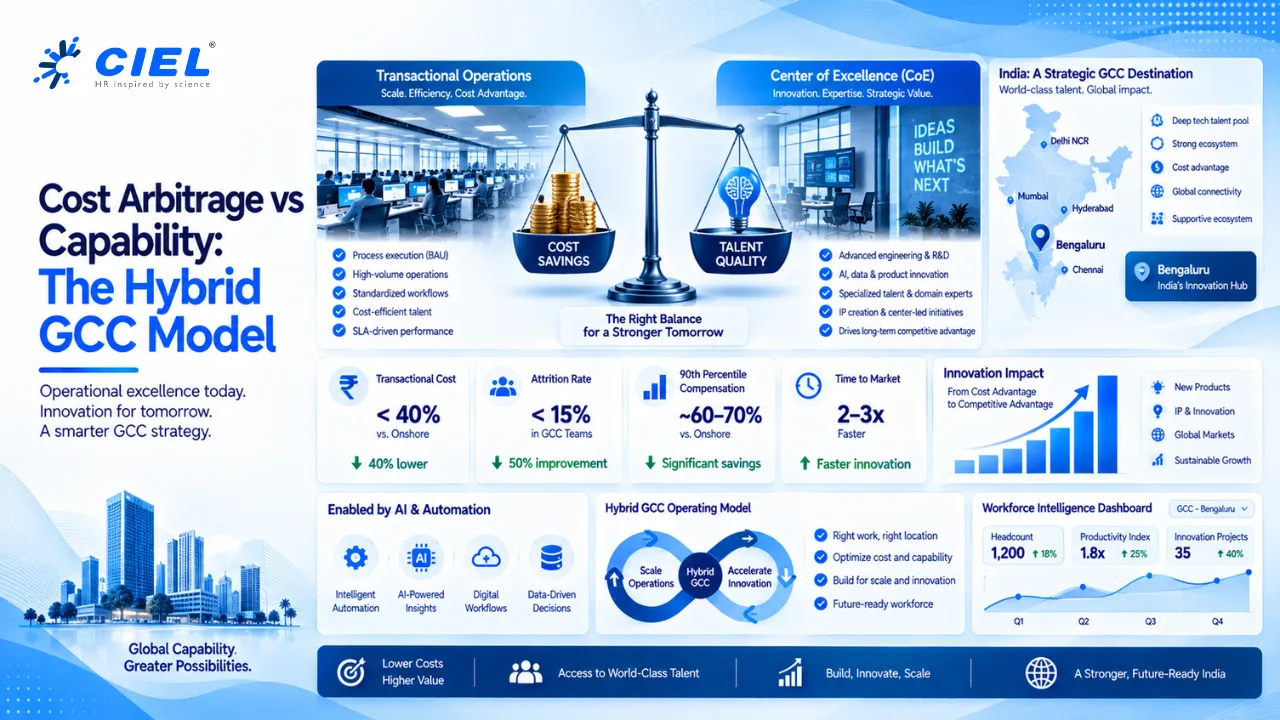
Enterprise leaders evaluating where to establish global operations face a strict binary: optimize for immediate cost reduction or invest in premium talent. A hybrid Global Capability Center (GCC) integrates cost-arbitrage transactional processes with capability-based talent acquisition , enabling organizations to reduce operational expenditure while securing specialized engineering skills.
Why Do Traditional GCC Evaluation Frameworks Fail?
Traditional cost-centric GCC models evaluate success strictly on wage arbitrage and headcount ratios, ignoring the strategic value of innovation output. This approach creates a misalignment where organizations attempt to execute complex engineering tasks using procurement rules designed for back-office processing. Prioritizing short-term cost savings over building capabilities introduces long-term risks, particularly high technical debt and severe attrition among top performers .
The failure of standard evaluation frameworks becomes acute as artificial intelligence alters the outsourcing landscape. AI systems and Robotic Process Automation (RPA) are actively commoditizing routine, rules-based workflows. When enterprise leaders evaluate a GCC solely on its ability to provide cheap labor for manual tasks, they invest in an operating model that software will soon render obsolete. Evaluating a modern GCC requires assessing its capacity to manage, train, and deploy advanced technologies, rather than just executing manual processes at a lower hourly rate.
How to Align the GCC Operating Model With Specific Business Functions?
Aligning the GCC operating model with specific business functions requires mapping task complexity to talent availability , ensuring R&D units receive capability-based funding while finance units operate on efficiency-driven cost arbitrage. This structural alignment prevents overspending on routine processes and ensures critical intellectual property development is not starved of resources.
Determining how to align the GCC operating model with specific business functions like R&D versus finance involves splitting the procurement strategy. Finance, payroll, and basic IT service desk functions thrive in a cost-arbitrage environment where repeatable processes can be standardized and scaled. Conversely, R&D, product engineering, and quantitative analysis require a capability-based approach. The roadmap for evolving a cost-arbitrage GCC into a strategic innovation hub starts by isolating these high-value functions into dedicated Centers of Excellence (CoE), isolating their budgets and KPIs from the transactional side of the business.
What Are the Key Metrics to Measure ROI in a Capability-Based GCC?
Measuring the ROI of a capability-based GCC relies on innovation velocity and talent retention metrics, shifting the focus away from simple wage differentials. This framework demonstrates the actual business value generated by advanced engineering hubs, proving that higher upfront talent costs yield faster product delivery and superior intellectual property.
To evaluate effectively, procurement and operations teams must adopt specific diagnostic rules rather than relying on legacy headcount formulas.
GCC Evaluation Thresholds
- Condition A (Innovation Output): If the primary objective is generating new intellectual property, treat a first-year attrition rate above 15% as a high-risk indicator for capability-based models. Action: Restructure compensation bands to target the 90th percentile of the local market to stabilize the engineering core.
- Condition B (Transactional Automation): If the function relies on routine data processing, apply a strict cost ceiling. As a working heuristic, keep transactional process costs under 40% of total GCC operating expenditure. Action: Deploy Robotic Process Automation (RPA) to maintain the operating margin without adding headcount.
- Condition C (Time-to-Market): For R&D centers, evaluate the deployment speed of new features. A time-to-market reduction of less than 10% post-deployment indicates poor capability integration. Action: Audit the DevOps pipeline and remove onshore dependencies that block offshore autonomous releases.
What Does an Evaluation Failure Look Like in Practice?
Illustrative example: The steering committee at a global financial services firm evaluated a new Global Capability Center (GCC) deployment in Bangalore specifically to handle quantitative risk modeling. Their procurement scorecard weighted wage arbitrage at 70%, treating data science roles identical to back-office processing headcount. They selected a tier-two facility and capped compensation bands at the 50th percentile for the local market.
By month six, the exact cost of this evaluation gap materialized. The GCC successfully hired 40 analysts, but the team lacked the specialized Python and machine learning expertise required to migrate the firm’s legacy risk models. When the internal audit team reviewed the new models, they found critical latency issues that the offshore team could not resolve. The firm assumed standard operational metrics covered advanced technical output, completely missing the specialized requirements of quantitative engineering.
Correctly evaluating this deployment as a capability-based hub would have shifted the criteria from headcount cost to technical validation. A capability-focused scorecard would have flagged the compensation cap as a blocker for senior data scientists and required a technical sandbox test during vendor selection. Because they optimized for cost, the firm saved $2 million in payroll but delayed their risk platform migration by three quarters, costing significantly more in extended legacy software licenses and missed market opportunities.
How Does a Hybrid GCC Compare to Traditional Models?
A hybrid GCC model balances cost savings with strategic talent acquisition by running transactional operations on cost arbitrage while establishing isolated Centers of Excellence for high-value engineering. This dual-track structure maximizes cost efficiency on routine tasks without sacrificing the technical innovation required for core product development.
| Evaluation Feature | Hybrid Capability Model | Traditional Cost Arbitrage |
|---|---|---|
| Primary Focus | Talent quality & specialized innovation | Headcount reduction & wage savings |
| Core ROI Metric | Time-to-market & IP creation | Cost per full-time equivalent (FTE) |
| AI Impact Strategy | Augments specialized engineering output | Threatens baseline transactional roles |
| Talent Compensation | 90th percentile for CoE roles | 50th percentile market average |
| Operational Structure | Separated R&D and transactional units | Homogenized processing floors |
What Are the Trade-Offs of Adopting a Capability-Based Model?
Establishing a capability-based hub requires higher initial operational expenditure and requires longer ramp-up periods to source specialized talent. These constraints mean the model is inappropriate for organizations seeking immediate cash-flow relief or those outsourcing purely administrative tasks.
- Not suitable when: The enterprise requires immediate operational expenditure reduction within a single fiscal quarter, or the outsourced processes are entirely rules-based, standardized, and easily automated.
- Consideration: The parent organization must commit to integrating the GCC into core strategic planning, requiring ongoing travel, cultural alignment, and shared technology infrastructure, rather than treating the center as a siloed vendor.
- Trade-off vs alternative: Establishing a capability-based hub requires higher initial capital expenditure for premium real estate and aggressive talent acquisition compared to a traditional cost-centric deployment. Measure this higher upfront cost directly against the projected timeline for new intellectual property generation.
Evaluate your organization’s readiness for a hybrid GCC model by mapping your current operational workflows against capability requirements to determine which processes demand premium talent and which can be optimized for cost.
Frequently Asked Questions
What is the decision framework for choosing between a cost arbitrage and a capability-based GCC?
The decision framework maps process complexity against required intellectual property generation. If a business unit executes highly standardized, repeatable workflows, a cost arbitrage model provides the best efficiency. If the unit drives product engineering, data science, or core intellectual property, a capability-based model is required to attract and retain premium talent.
What are the technical prerequisites for integrating a capability-based GCC?
A capability-based GCC requires secure, low-latency access to the parent organization’s core development environments. Technical prerequisites include implementing zero-trust network architecture, standardizing DevOps pipelines across regions, and ensuring active directories are fully federated so offshore engineers have identical system access to onshore teams.
What are the key metrics to measure the ROI of a capability-based GCC versus a cost-centric one?
Cost-centric models measure ROI through wage differentials and cost-per-seat reductions. Capability-based models measure ROI through time-to-market acceleration for new features, the volume of patents or intellectual property generated, and the retention rate of specialized engineering talent over a multi-year horizon.
How is AI impacting the long-term value of pure cost-saving GCC models?
Artificial intelligence directly threatens the viability of pure cost-saving models by automating the routine, rules-based tasks those centers were built to execute. As software handles basic data entry and tier-one support, organizations must transition these centers into capability hubs focused on managing and training AI systems rather than performing manual processing.
What is a hybrid GCC model that balances cost savings with strategic talent acquisition?
A hybrid GCC model physically or logically separates operations into two distinct tracks. Transactional business processes operate under strict cost-arbitrage rules with capped compensation, while isolated Centers of Excellence (CoE) within the same facility operate with uncapped budgets to secure top-tier engineering and research talent.
What is the roadmap for evolving a cost-arbitrage GCC into a strategic innovation hub?
The roadmap begins by identifying one high-value process, such as data analytics or cloud architecture, and carving it out from standard procurement metrics. Leadership must then adjust compensation bands to the 90th percentile for that specific unit, deploy advanced training programs, and shift KPIs from cost-per-headcount to product delivery milestones.
