

Table of Contents
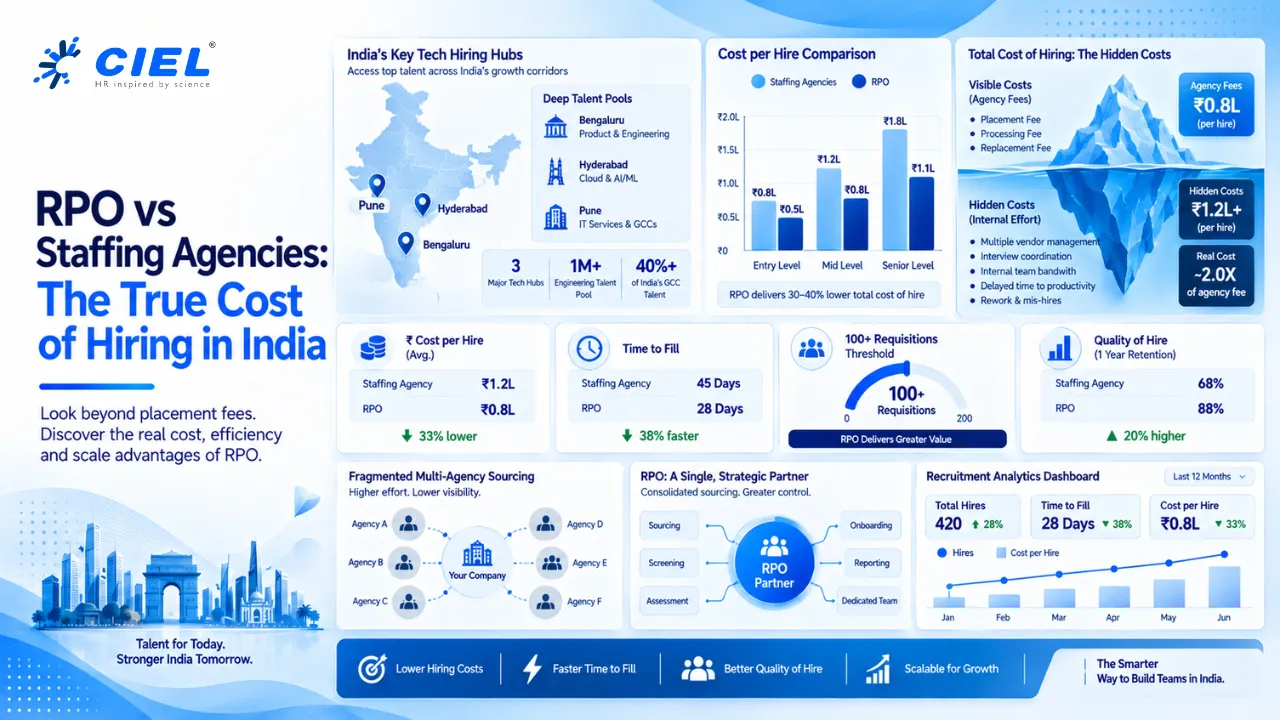
How do organizations in India determine the true cost difference between Recruitment Process Outsourcing (RPO) and traditional staffing agencies ? Evaluating these models requires looking beyond fixed placement fees to measure total talent acquisition expenditure. Recruitment Process Outsourcing integrates directly into internal HR workflows to manage the full hiring cycle, reducing redundant sourcing costs and standardizing candidate evaluation.
Why Do Standard Staffing Evaluations Fail to Capture True Costs?
Traditional staffing models charge a percentage-based fee per successful hire, isolating the cost of external sourcing from internal operational expenses. This fragmented approach obscures hidden expenses like extended time-to-fill, redundant screening hours, and lost productivity. Consequently, organizations comparing only the agency markup fail to measure the total cost of ownership for talent acquisition .
When procurement teams evaluate vendor performance based solely on individual placement costs, they ignore the operational drag placed on internal engineering and management teams. A traditional agency submits external profiles, leaving the internal human resources department to manage the technical gating, interview scheduling, and feedback loops. The cost of those internal hours rarely appears on the agency invoice, creating an incomplete financial picture.
At What Point Should a Fast-Growing Startup Switch to an RPO Solution?
An RPO partnership replaces decentralized agency management with a unified talent acquisition infrastructure. This consolidation standardizes employer branding and candidate experience across all touchpoints. As a working evaluation threshold, organizations benefit from transitioning to an RPO model when sustained annual hiring volume exceeds 100 dedicated requisitions.
To evaluate readiness for an RPO transition, apply this operational authority block:
- Hiring Volume: Sustained requisition load >100 per year = Proceed to RPO evaluation.
- Cost per Hire Variance: Internal variance >20% across departments = High Risk. Action: Standardize pricing structures via RPO.
- Time-to-Fill: Critical roles remaining open >60 days = High Risk. Action: Evaluate dedicated sourcing models to build proactive talent pipelines.
- Agency Dependency: Utilizing >3 overlapping external agencies for similar roles = High Risk. Action: Consolidate under a single RPO provider.
- Candidate Drop-off: Interview-to-offer drop-off rate >30% due to slow feedback loops = High Risk. Action: Implement RPO workflow integration to accelerate communication.
What Happens When Organizations Misalign Their Recruitment Strategy?
Consider a hypothetical scenario: A Bengaluru-based software startup reaches its Series B funding round and needs to scale its engineering team by 150 engineers within twelve months. The talent acquisition director splits the requisitions across five traditional staffing agencies to maximize candidate flow.
The initial weeks yield hundreds of resumes, but the internal HR team quickly becomes the bottleneck. Because the agencies operate independently, they submit duplicate candidates, requiring the internal team to manually cross-reference submissions to resolve ownership disputes. The hiring managers spend ten hours a week interviewing candidates who lack the specific tech stack experience required, as the agencies prioritize speed of submission over technical alignment.
This is the cost of misaligned evaluation criteria. The director measured success by the sheer volume of inbound profiles rather than the operational burden placed on internal teams. The total cost of hire balloons when accounting for the engineering hours spent on failed technical screens.
Switching the evaluation framework changes this outcome. When the same organization shifts to an RPO provider, the external team embeds within the internal applicant tracking system and conducts the initial technical gating. The internal engineering managers only interview pre-vetted candidates, dropping interview hours by over half and accelerating the actual time-to-fill for critical roles.
How Do RPO and Traditional Staffing Compare Across Key Metrics?
Comparative talent evaluation frameworks assess recruitment models against scalability, cost structure, and candidate experience. This structural analysis dictates which sourcing mechanism best aligns with specific business objectives. A hybrid model combining RPO for volume hiring and staffing agencies for niche executive roles balances these operational demands.
| Feature | Recruitment Process Outsourcing (RPO) | Traditional Staffing Agencies |
|---|---|---|
| Cost Structure | Fixed monthly management fee plus reduced placement fee | High percentage-based fee per successful hire |
| Scope of Work | End-to-end talent acquisition cycle management | Sourcing and initial screening only |
| Employer Branding | Operates under the client’s brand identity | Operates under the agency’s brand identity |
| Scalability | Highly scalable for sustained volume hiring | Flexible for immediate, short-term headcount spikes |
| Internal Integration | Embedded within internal HR tech stack (e.g., Workday, Greenhouse) | External vendor relationship with transactional handoffs |
How Does an RPO Partner Improve Employer Branding in the Indian Market?
Traditional staffing agencies prioritize their own brand identity during candidate outreach , creating a fragmented initial touchpoint for the applicant. Recruitment Process Outsourcing providers operate as a white-labeled extension of the hiring organization, utilizing the client’s official communication channels. This unified presentation eliminates candidate confusion and standardizes the screening experience.
In highly competitive tech hubs like Hyderabad and Pune, candidate experience dictates offer acceptance rates. When applicants receive outreach from multiple agencies representing the same company, it signals internal disorganization. An RPO model centralizes this communication, ensuring that candidates receive consistent messaging regarding company culture, technical expectations, and compensation structures from the first point of contact.
What Are the Potential Risks of Committing to an RPO Model?
Committing to an RPO model requires significant upfront workflow integration and long-term volume commitments. This structural rigidity creates financial risk if hiring projections drop unexpectedly. Evaluating these operational trade-offs prevents organizations from over-engineering their talent acquisition strategy.
- Not suitable when: Hiring needs are highly volatile, strictly project-based, or restricted to a few niche executive roles where dedicated infrastructure is unnecessary.
- Consideration: Requires extensive initial integration with existing internal applicant tracking systems and HR workflows before sourcing begins.
- Trade-off vs alternative: Demands longer-term contract commitments compared to the transactional, zero-commitment nature of traditional staffing agencies.
What Are the Key Steps to Transition to a Single RPO Partner?
Transitioning to a single RPO partner requires a phased migration of talent acquisition workflows from legacy agencies to the centralized provider. This structured implementation prevents sourcing disruptions during the handover phase. Defining clear service level agreements (SLAs) ensures the new partner maintains operational continuity.
- Conduct a total cost of ownership audit on current agency spend, factoring in internal hours spent on screening.
- Define specific SLAs for time-to-fill, candidate quality, and cost-per-hire targets.
- Integrate the RPO team into internal communication channels and HR systems (ATS/HRIS) using secure access protocols.
- Execute a phased rollout, starting with high-volume, lower-complexity roles before transitioning senior technical requisitions.
Evaluate your current talent acquisition spend against industry benchmarks to determine if an RPO transition aligns with your growth trajectory.
Frequently Asked Questions
How does an RPO partner integrate with internal technical infrastructure?
Recruitment Process Outsourcing providers embed directly into the organization’s existing Applicant Tracking System (ATS), such as Greenhouse or Workday. This technical alignment allows them to operate natively within internal workflows, maintaining data consistency and seamless candidate handoffs without requiring infrastructure overhauls.
What is the typical ROI timeframe for an RPO deployment?
As a prescriptive baseline, organizations transitioning from high-volume agency usage to a structured RPO model should evaluate initial return on investment within the first six to nine months. This window allows the provider to optimize sourcing channels, reduce external agency dependency, and stabilize the baseline cost-per-hire.
How does the RPO mechanism improve candidate experience?
An RPO team operates as a direct extension of the client’s internal HR department, utilizing the company’s official email domains and brand messaging. This white-labeled mechanism provides candidates with a cohesive, unified communication experience from initial outreach through final onboarding.
Can Indian companies use a hybrid model combining RPO and staffing agencies?
Yes, organizations frequently deploy a hybrid recruitment architecture. They utilize the RPO provider to manage high-volume, standardized hiring requisitions while retaining specialized traditional staffing agencies to execute targeted searches for niche executive or highly specialized technical roles.
How do you measure the performance of an RPO partner versus traditional agencies?
Performance measurement requires tracking metrics beyond simple fill rates. Organizations evaluate the RPO partner against specific service level agreements, focusing on candidate retention rates, interview-to-offer conversion ratios, and the reduction in internal hiring manager time spent on initial screening.
