

Table of Contents
CEO Search: Retained vs Contingency Executive Decision Matrix
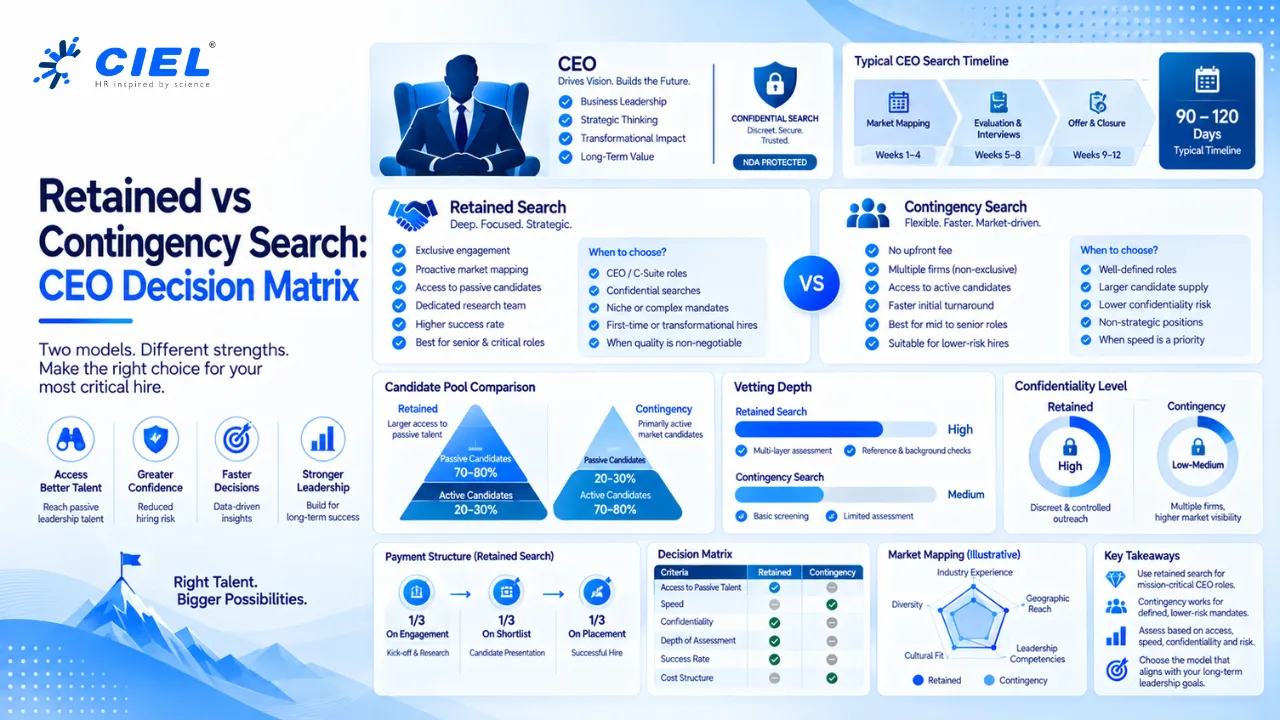
The choice between retained and contingency executive search defines resource allocation, confidentiality, and candidate vetting depth for a C-level hire. Retained search secures a dedicated advisory team through an exclusive contract and upfront fee, guaranteeing systematic market mapping. Contingency search operates on a success-fee basis without exclusivity, delivering rapid candidate pipelines from active job seekers.
Selecting the correct model requires aligning organizational urgency, role complexity, and confidentiality requirements with the search firm’s operational structure. Treating these distinct sourcing methodologies as interchangeable pricing models compromises the integrity of the leadership acquisition process.
Why Do Standard Executive Search Evaluations Fail?
Standard executive search evaluations fail because they treat contingent and retained models as interchangeable pricing structures rather than fundamentally different candidate acquisition mechanisms . This misalignment results in compromised confidentiality or extended vacancies for critical leadership roles.
Organizations often default to contingency search to avoid upfront costs, assuming the lack of financial commitment reduces risk. However, this approach creates misaligned incentives where firms prioritize placement speed over rigorous candidate vetting and strategic alignment. Because contingency recruiters only earn a fee if they win the race to submit a resume, they focus on active job seekers rather than extracting passive market leaders. Conversely, defaulting to retained search for lower-impact, high-volume management roles wastes capital on unnecessary market mapping when rapid pipeline generation is the actual requirement.
What Criteria Determine the Right Executive Search Model?
An executive search decision matrix evaluates role criticality, confidentiality constraints, and market scarcity to dictate the appropriate sourcing model . Applying this framework ensures the chosen search partner aligns their resource allocation with the organization’s specific hiring mandate.
- Compensation Threshold: Base salary > $250,000 = HIGH COMPLEXITY. Action: As a prescriptive evaluation heuristic, mandate retained search to ensure dedicated resource allocation for enterprise-level compensation negotiations.
- Role Confidentiality: Status = Incumbent replacement. Action: Deploy retained search under strict non-disclosure agreements before revealing the organizational identity to the market.
- Market Scarcity: Target talent pool = Passive executives at direct competitors. Action: Require retained search to navigate off-limits directories and execute targeted headhunting.
- Vetting Protocol: Requirement = Board-level behavioral assessment. Action: Engage retained search partners operating under AESC (Association of Executive Search and Leadership Consultants) guidelines.
- Diversity Compliance: Requirement = Documented market mapping. Action: Utilize retained search to generate comprehensive talent pool data supporting EEOC (Equal Employment Opportunity Commission) compliance reporting.
How Does Evaluation Failure Impact the Organization?
Poorly matched search models actively damage employer brand equity by broadcasting confidential leadership changes or failing to secure passive candidates. This operational friction delays critical strategic initiatives and exposes the organization to competitive vulnerabilities.
Illustrative example: A mid-market fintech company’s board of directors initiates a confidential replacement for their underperforming Chief Revenue Officer. To avoid upfront retainer fees, the compensation committee engages three separate contingency search firms simultaneously, assuming competition will drive faster results. Because contingency firms only earn fees upon placement, the recruiters immediately blast the job description to their existing databases and LinkedIn networks to secure candidate ownership.
Within 48 hours, the incumbent CRO learns of their impending termination through industry rumors, triggering their immediate resignation and threatening client relationships. Meanwhile, the targeted passive candidates—senior executives at rival firms—ignore the outreach because the scattershot approach lacks the discretion and strategic framing required for a lateral C-suite move.
The board is left with an abrupt leadership vacuum, a damaged market reputation, and a pipeline consisting entirely of active, unemployed candidates. A retained search model prevents this by enforcing a single point of contact, utilizing non-disclosure agreements before revealing the company name, and conducting a systematic, confidential extraction of passive market leaders. The attempt to save a nominal upfront fee ultimately costs the organization critical revenue continuity and extends the vacancy timeline by months.
What Are the Key Differences Between Retained and Contingency Search?
A structural comparison between retained and contingency search highlights the divergence in exclusivity, fee structure, and candidate vetting depth. Understanding these operational differences clarifies which model provides the necessary commitment for a strategic leadership hire.
| Feature | Retained Search | Contingency Search |
|---|---|---|
| Financial Structure | Three-stage milestone payments | 100% success fee upon placement |
| Exclusivity | Exclusive partnership | Non-exclusive, multi-agency competition |
| Candidate Pool | Passive executives and market mapping | Active job seekers and database matches |
| Confidentiality | High (NDA-gated outreach) | Low (Broad market broadcasting) |
| Vetting Depth | Behavioral, psychometric, and board-level assessment | Standard resume screening and initial interviews |
What Are the Trade-Offs of Using Retained Executive Search?
Retained executive search demands significant upfront capital and operational patience, trading immediate candidate volume for systematic market penetration. This resource-intensive methodology is inefficient for lower-level management roles or high-volume hiring initiatives.
- Not suitable when: The organization requires rapid, high-volume placement for mid-level management positions where candidate scarcity is low and active job seekers meet the technical requirements.
- Consideration: The organization must commit to a three-stage payment structure, typically billing one-third of the estimated fee at contract signing, regardless of immediate placement outcomes.
- Trade-off vs alternative: Retained search requires a 90-to-120-day exclusive timeline for comprehensive market mapping, sacrificing the immediate candidate volume generated by deploying multiple competing contingency firms simultaneously.
To finalize your executive search strategy, evaluate your specific timeline, confidentiality constraints, and budget against this decision matrix. Select the search partner whose operational model aligns directly with the complexity of your C-level mandate.
Frequently Asked Questions
When should I use retained search over contingency for a C-level hire?
Retained search provides dedicated resource allocation for C-level hires requiring strict confidentiality, comprehensive market mapping, and board-level behavioral assessments. This exclusive model is necessary when targeting passive executives at rival firms who will not respond to broad contingency solicitations.
What are the key differences in cost and fee structure between retained and contingency executive search?
Retained search utilizes a three-stage milestone payment structure, billing one-third of the total fee at signing, shortlist presentation, and final placement. Contingency search operates entirely on a success-fee basis, requiring zero upfront capital and billing 100% of the fee only if their specific candidate is hired.
Which search model provides a higher level of commitment for a critical CEO role?
Retained search delivers a higher level of commitment through an exclusive contractual partnership. The upfront retainer guarantees the search firm allocates dedicated research teams to map the entire talent market, whereas contingency firms prioritize easily accessible active candidates to maximize their own placement speed.
How do the success rates for retained versus contingency search compare for senior leadership roles?
Retained search yields higher completion rates for senior leadership roles because the exclusive mandate allows for exhaustive passive candidate extraction and rigorous vetting. Contingency search success rates drop sharply for CXO positions because multiple competing firms duplicate outreach efforts, alienating high-level executive talent.
Is retained search better for a confidential or highly specialized executive position?
Retained search is mandatory for confidential and highly specialized executive positions. The methodology requires candidates to sign non-disclosure agreements before the hiring organization is revealed, preventing market rumors and protecting employer brand equity during sensitive leadership transitions.
What are the pros and cons of using a contingency firm to find a senior executive?
The primary benefit of a contingency firm is the absence of upfront financial risk, allowing organizations to review active candidates quickly. The main drawback for senior roles is the lack of dedicated market mapping, resulting in shallow vetting protocols and high risks of confidentiality breaches.
How does the candidate vetting process differ between retained and contingency models?
Contingency models rely on standard resume screening and initial interviews to rapidly submit candidates before competing agencies. Retained models execute deep vetting protocols, including psychometric testing , leadership competency frameworks, and adherence to AESC (Association of Executive Search and Leadership Consultants) standards for board-level evaluation.
